How Vegetable Tanned Leather Develops a Stunning Patina
In this article
Most leather goods age poorly. The surface cracks. The finish peels. Within a few years, what looked new looks worn out.
Full grain vegetable tanned leather does the opposite — it gets better. The surface deepens, darkens, and develops a sheen that is entirely its own. This process is called a leather patina, and understanding it changes how you think about owning leather goods.
This guide explains what patina is, why it only happens in certain leathers, what drives it, how it progresses over time, and how to care for your leather at every stage.
Key Takeaways
- Patina needs an open, uncoated surface. Vegetable tanned full grain has one. Chrome tanned, top grain, and bonded leather do not, so they wear rather than improve.
- The difference starts at the tannery. Wickett & Craig puts hides through roughly six weeks of bark liquor; Hermann Oak's pit stage alone runs four to six weeks. Chrome tanning reaches wet blue in about a day.
- Sunlight darkens veg tan because quinones form on the tannin's phenolic structure. The same research shows prolonged irradiation eventually reverses into lightening, which is why controlled exposure beats a long sunbath.
- Expect subtle edge darkening in weeks, an obvious patina by three to six months, and a deep layered one after a year or two of daily carry.
- Condition every three to six months. A supple hide patinas evenly; a dry one cracks in the places you use most.
What Is Leather Patina?
Patina is the visible record of a leather good's life with its owner. It is a gradual transformation of the surface, a darkening and softening with a subtle sheen, caused by exposure to the oils in your hands, natural light, air, and everyday use.
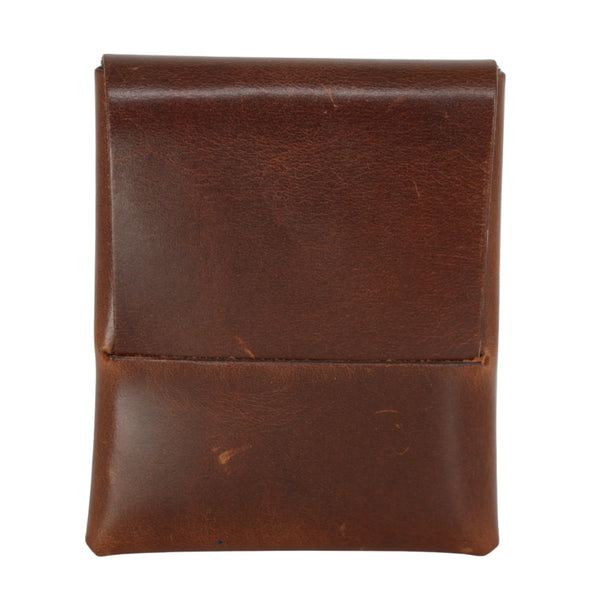
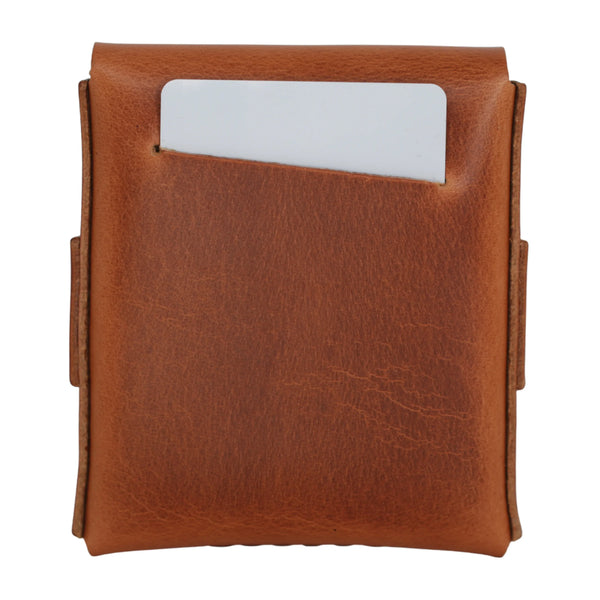
A wallet at the end of its first week looks very different from the same wallet at the end of its first year. The color is richer. The surface has a warmth and depth that wasn't there when it arrived. The areas you touch most — the edges, the front face — run ahead of the areas that see less contact. Every mark, fold, and worn corner carries the history of every time you used it.
This is not damage — it's the leather becoming more itself.
Patina is also impossible to fake convincingly. Manufacturers have tried — artificial aging treatments, distressed finishes, pre-worn surfaces. None of them look like the real thing, because genuine patina is shaped by one person's specific use over time. It is individual in the truest sense.
Why Only Vegetable Tanned Leather Develops True Patina
Not all leather develops patina. The tanning method decides whether it's even possible.
Vegetable tanning is the traditional method. Tannins pulled from plant sources, including oak bark, chestnut, mimosa, and quebracho, convert raw hide into leather over weeks. The result keeps most of its natural fiber structure and stays open enough at the surface to absorb oils, respond to light, and build character.
The timescale isn't a marketing claim. You can read it off the tanneries themselves. Wickett & Craig, the Curwensville, Pennsylvania tannery, describes a yard of 72 vats filled with a blend of mimosa and quebracho bark. Hides soak for two weeks in liquor that is continually replenished and recirculated, and the tannery states that "the entire process takes around six weeks." Hermann Oak of St. Louis describes a pit of custom-blended oak, chestnut, and hemlock bark extracts, with that stage alone "lasting four to six weeks." (Both retrieved 2026-08-07.)
Chrome tanning uses chromium salts in a rotating drum and reaches the stage tanners call wet blue in a matter of hours, typically inside a single day. It's faster and cheaper, and the leather comes off softer and more water resistant straight from the tannery, which is why it dominates the mass market. But that process seals the surface against the kind of interaction that creates patina. Chrome tanned leather doesn't develop a true patina. It simply wears.
Full grain vegetable tanned leather develops the richest patina of any leather type, because the two requirements stack. Full grain keeps the intact outer surface that interacts with the world. Vegetable tanning keeps that surface open enough for the interaction to happen.
Both halves of that phrase have to be true. If the grain has been sanded off there's no surface left to darken, whichever way the hide was tanned. Our guide to what full grain leather is covers the four checks that tell you which grade you're actually holding.
What Causes Patina to Form?
Patina is the cumulative result of four forces working slowly at once.
Natural Oils from Your Hands
The sebum on your skin transfers to the leather every time you handle it. Those oils work into the surface fibers, darkening them and raising a soft sheen wherever contact is heaviest. It's why the edges and front face of a wallet pull ahead of the back panel.
Light Exposure
This is the part most guides get half right. UV light doesn't simply "fade" or "tan" the leather. It chemically alters the tannin itself.
Pizzi, Simon, George, Perrin and Triboulot studied exactly this in Tannin antioxidant characteristics in leather versus leather light stability: Models (Journal of Applied Polymer Science, vol. 91, no. 2, pp. 1030–1040, 2003). Under irradiation, vegetable tanned leather darkens as quinones form on the phenolic structure of the tannin. That reaction is what you're seeing when a pale hide turns honey and then amber.
The same body of work carries a warning worth acting on. Darkening is only the first phase. Under prolonged irradiation the darkening reaction is followed by a lightening one, as the collagen structure weakens and degrades. Sunlight is a tool with a ceiling — not a dial you can keep turning.
Air and Oxidation
Oxygen slowly oxidizes the surface tannins, adding to the darkening over time. This one is passive. There's nothing to do but use the leather and let time pass.
Friction and Compression
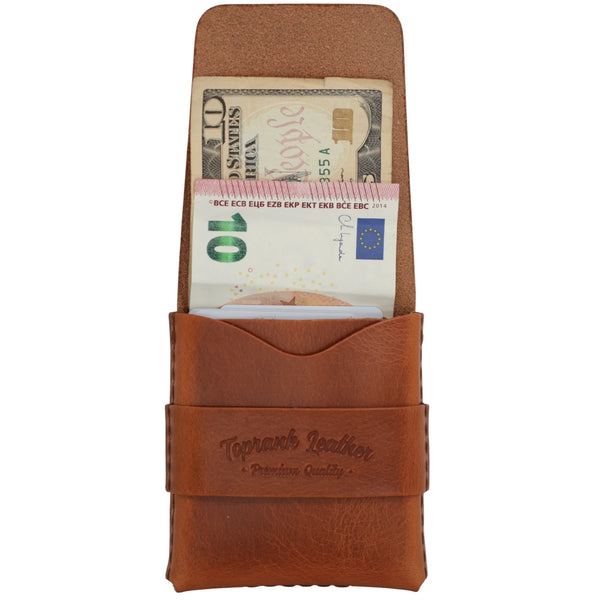
Handling compresses and burnishes the surface fibers, which produces the glassy sheen you see on well-aged pieces. Wallet corners and pocket edges get there first. On a folded card holder the crease runs ahead of everything else, which is why stitchless construction ages along one clear line rather than across a whole panel.
Friction is also why carry position changes the result. A keyring gives leather far more abrasion and far less daylight than a wallet does, so the burnish arrives before the colour — we set out what that does over three years on a keyring in a separate comparison.
Which Tannin the Tannery Used Changes How It Ages
Two vegetable tanned wallets can age differently, and the reason usually sits in the tanning pit rather than in how you carried them.
Vegetable tannins split into two families. Falcão and Araújo set this out in their review Vegetable Tannins Used in the Manufacture of Historic Leathers (Molecules, vol. 23, no. 5, article 1081, 2018). It's an open access survey of how European hides were tanned, and of how those same tannins are identified in museum objects today. The full text is free to read if you want the chemistry in detail.
- Condensed tannins come from sources such as mimosa and quebracho. They resist chemical degradation well, but they are the more oxidation-prone of the two.
- Hydrolysable tannins come from sources such as chestnut, oak galls, sumac, and tara. They are the more vulnerable family to chemical breakdown.
The practical takeaway is small but genuinely useful. Bark blends are rarely a single tannin, so this won't hand you a formula. What it does explain is why two honest veg tan wallets, bought from two different tanneries, can head toward different shades of brown on the same wrist. If a maker won't tell you which tannery or which bark they buy, that's worth noticing.
Patina Timeline: What to Expect Month by Month
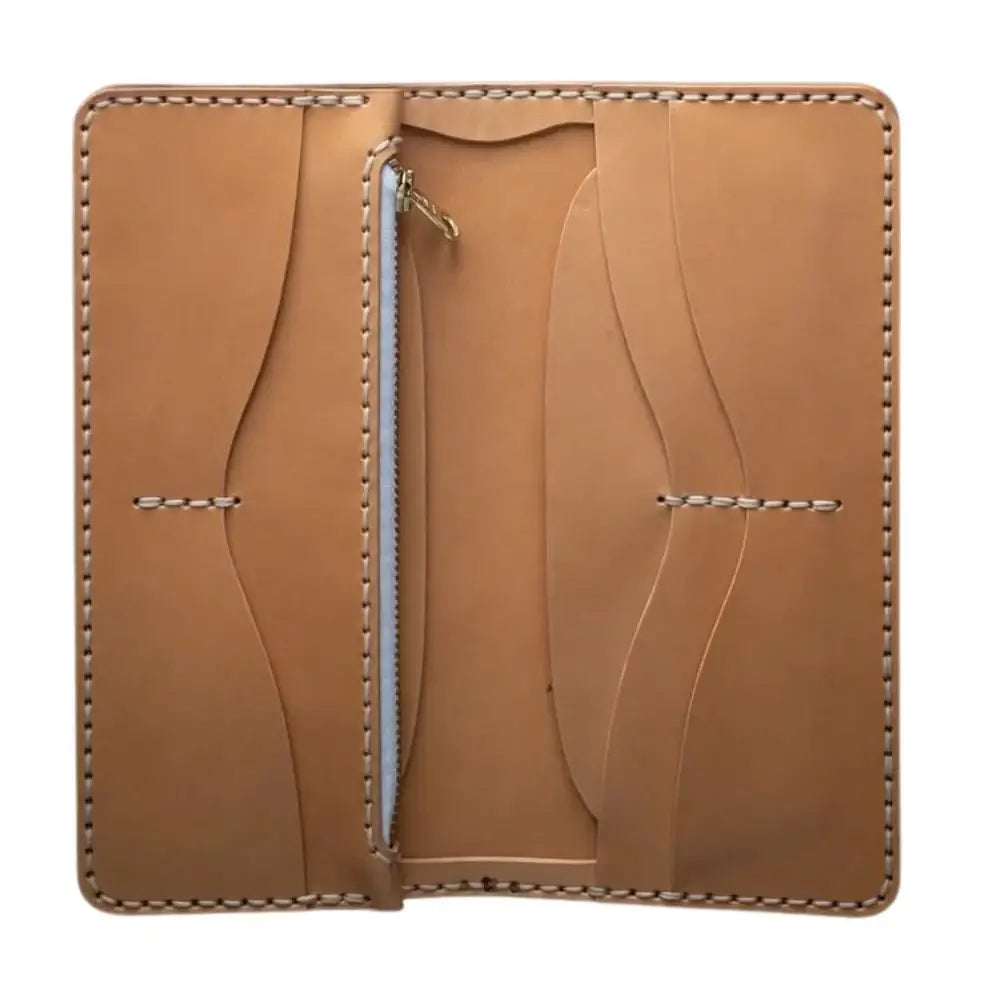
Vegetable tanned leather usually arrives pale, in a natural tan sometimes called "naked" leather. Here's how it moves.
First Week
Very little visible change. You may catch slight darkening along edges and high-contact areas if you handle it often. The leather is taking up its first oils and starting to soften. Colour and stiffness run on separate clocks, and the stiffness one moves faster — how a new wallet breaks in covers what the first six weeks do to its shape.
One to Three Months
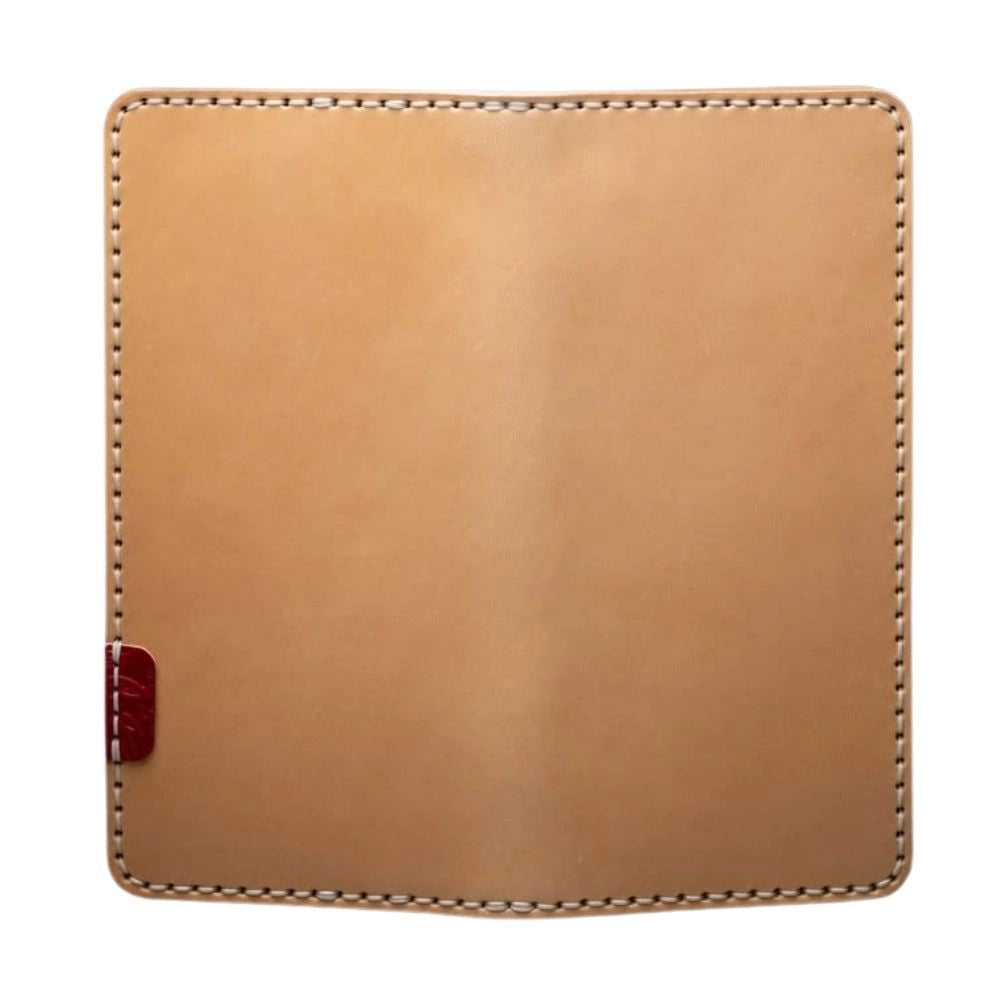
Now the shift is real. The leather has dropped several shades — hardest in the places your fingers land. A subtle sheen has come up in the busiest zones, and soft creases have set at the natural flex points. The piece has settled into your use pattern.
Six Months to One Year
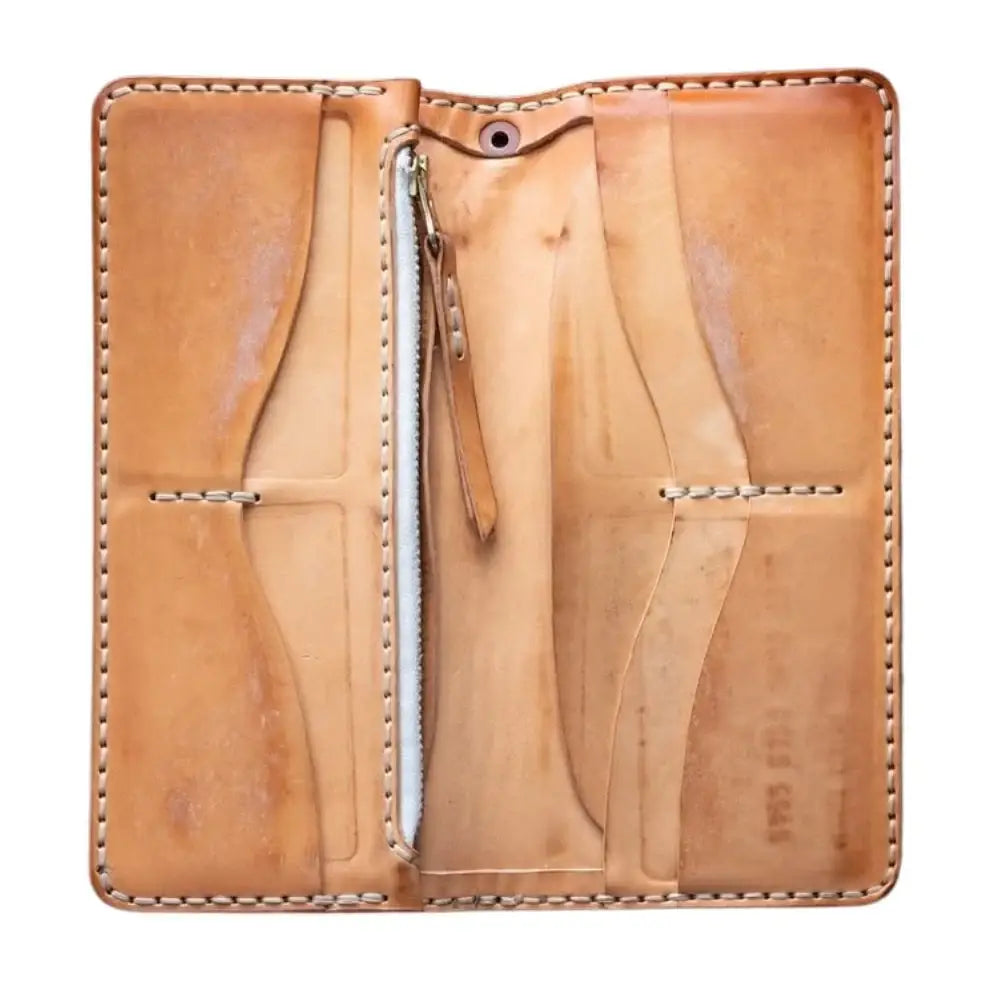
This is when patina becomes obvious even to people who don't know what they're looking at. The color is substantially richer. The sheen reads from across a room. Sharp corners have rounded, and the surface has a depth that photographs never quite catch. Put it next to a photo from the day it arrived and the change is startling.
You can see this stage without owning one yet. Our patina page carries a drag-to-compare photo of a single Toprank wallet, freshly made on one side and after two years in a pocket on the other. Same wallet, same light, two years apart.
Several Years
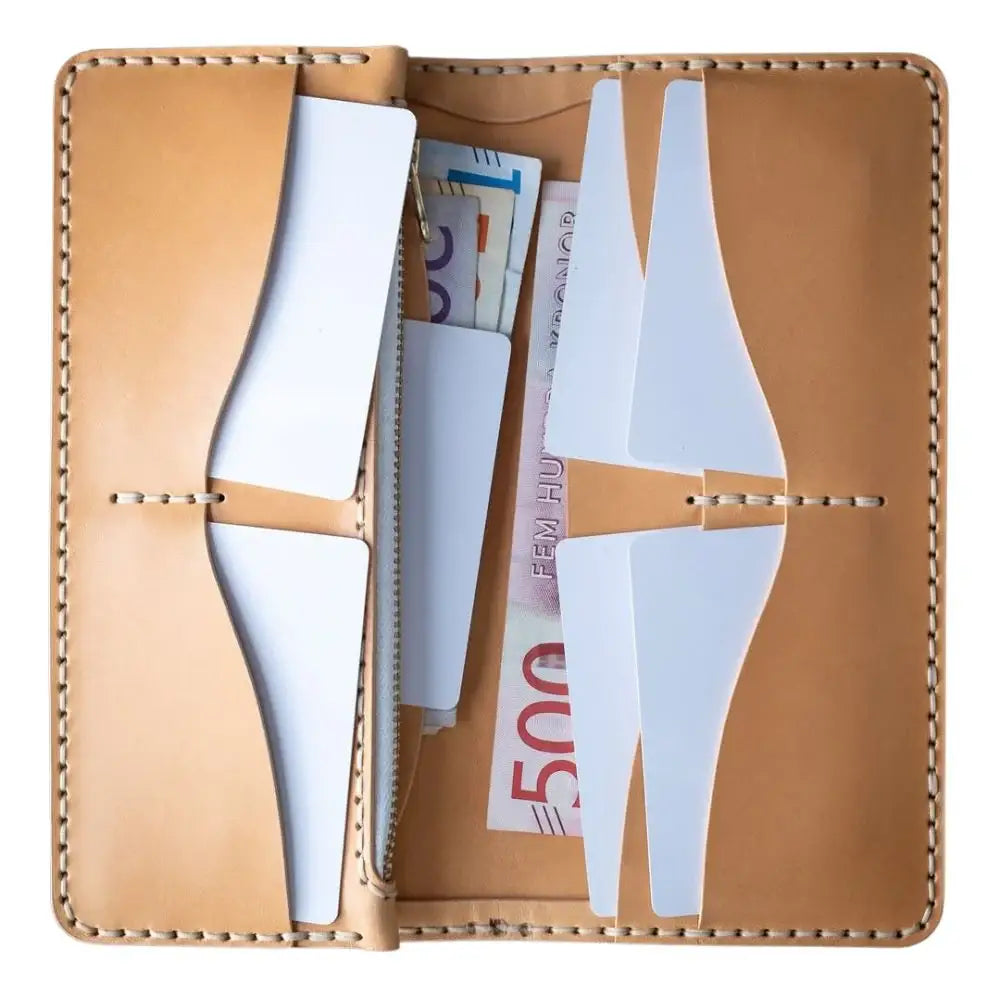
A fully developed patina is a remarkable thing. The color is deep and complex, not uniform but layered, with light and dark zones that map onto how you use it. The lustre is one no factory finish replicates. The leather has taken a slight set from its work: a wallet carries the faint impression of the cards inside it, a bag wears the marks of years of loading. Every scratch and worn corner is part of the object's character rather than damage to it.
How to Accelerate Patina Development
Patina can't be rushed to completion, but its pace can be encouraged.
Use It More
The most direct method is also the dullest: handle the thing. More skin contact, more friction, more exposure. Carry one wallet daily instead of rotating three.
Controlled Sun Exposure
A few hours near a sunny window, or outdoors in indirect sun, speeds the quinone reaction described above. It works best in the early weeks, while the hide is still pale.
Keep it short and keep it even. The Pizzi study is the reason: prolonged irradiation eventually flips from darkening into lightening as the collagen degrades. Rotate the piece so one face doesn't take all of it, and skip direct midday sun entirely.
Hand Conditioning
A small amount of natural conditioner, beeswax or lanolin based, helps the leather take up oils more evenly and nudges the darkening along. Apply sparingly, buff off the excess, and repeat every six to eight weeks while the patina is young.
Olive Oil, and Why We Don't Recommend It
Some leatherworkers brush on a thin film of olive oil to force early darkening. It does darken leather. It also carries real risk: too much goes blotchy, leaves a greasy hand, and can interfere with how the patina develops later. Food oils aren't formulated to stay stable inside a hide over years.
This is not a method our workshop uses or recommends. If you try it anyway, test on a hidden area first — the inside of a card slot works well. Wait a full week to see how that patch settles. Then use the smallest amount that shows any effect at all.
Caring for Your Leather Through the Patina Process
Good patina and good care aren't in tension. They're the same job. A properly maintained hide patinas evenly, while a neglected one cracks precisely where you use it most.
Condition Regularly
Every three to six months, work in a conditioner built from natural ingredients such as beeswax, lanolin, or a similar wax compound. Supple leather colors across the whole surface. Dry leather splits at the flex points first.
That schedule is for a hide that has settled. A wallet still in its first weeks is a different case: it left the tannery with its oils intact, and conditioning it too early softens the temper before the fold has set and stretches card slots that have not yet seated.
Fold lines need this most. A crease is where the fibers bend hardest, so on a folded card holder the fold is both the first place a patina shows and the first place dryness turns into a fissure.
Protect from Excessive Water
A little moisture is fine and even helps. Prolonged soaking is not. Water leaves marks, stiffens the hide as it dries, and darkens it unevenly. If your leather gets wet, blot off the excess and let it dry at room temperature, away from radiators and hair dryers.
That last instruction is not fussiness. Vegetable tanned leather has been measured shrinking at 72 °C, and the standard test that produces that figure is run with the leather submerged in water — which is why wet leather plus heat is the one combination that cannot be undone. The numbers are here.
Embrace the Scratches
Early scratches on pale leather look stark, and that's the stage where owners panic. Give it time. As patina builds, those marks sink into the overall depth of the surface. While the leather is still young, light surface scratches often buff out under a soft cloth or even a warm fingertip.
Avoid Harsh Chemicals
Solvent cleaners, bleach, and anything not made for natural leather will interrupt the patina and can permanently damage the surface. Use a soft damp cloth for dust, saddle soap for a deeper clean, and condition immediately afterwards. Test any new product on a hidden area first.
FAQ
How long does it take for vegetable tanned leather to develop a patina?
First visible changes typically appear within the first few weeks of regular use, as subtle darkening along edges and high-contact areas. A clearly noticeable patina usually arrives within three to six months. A fully rich, layered patina takes one to two years of regular carry. The timeline depends on how often you use the piece and how much it's handled.
Does all leather develop patina?
No. Patina requires a porous, uncoated surface that can absorb oils and react to its environment. Full grain vegetable tanned leather develops the richest patina. Chrome tanned leather develops very little, because the tanning process partially seals the surface. Top grain leather, with its sanded and coated finish, develops less still. Genuine and bonded leather do not patina at all; they deteriorate.
Can I speed up patina development?
You can encourage it through more frequent handling, short and controlled sun exposure, and regular conditioning with natural wax compounds. It can't be fully rushed. The character of genuine patina comes from accumulated use, and products claiming to age leather artificially rarely replicate it convincingly.
Will scratches and marks affect the patina?
Early scratches on pale leather look more visible than they ever will again. As patina develops, surface marks blend into the depth of the piece. Light scratches often buff out with a fingertip while the leather is new. Over time they read as character rather than damage.
How does vegetable tanned leather compare to chrome tanned for patina?
Vegetable tanned leather develops a significantly richer and more visible patina. Its plant tannins react actively with light, oils, and air, and that reaction is the patina. Chrome tanning partially seals the leather and limits the interaction. If patina matters to you, and for a wallet or bag you intend to carry for years it should, full grain vegetable tanned leather is the only category worth considering.
Does the type of bark used change how my leather ages?
It appears to, though not in a way that gives you a formula. Falcão and Araújo's 2018 review in Molecules separates vegetable tannins into two families. Condensed types, such as mimosa and quebracho, resist chemical degradation but oxidize more readily. Hydrolysable types, such as chestnut and oak galls, are more prone to chemical breakdown. Most tanneries blend barks rather than use just one — so treat this as an explanation for why two honest veg tan pieces drift toward different browns, not as a spec to shop by.
Does a stitchless wallet patina differently?
The chemistry is identical, but the pattern isn't. A sewn wallet darkens across whole panels and along its stitch lines. A folded one-piece card holder concentrates its earliest patina along the crease, because that is where the fibers compress hardest. Our guide to how a stitchless card holder is built covers what that fold does over the years, including where it eventually gives.
Does leather on a keyring patina differently?
The chemistry is the same, but the balance of the four forces shifts. A keyring gets constant abrasion and heavy hand contact, while spending most of its life in a pocket away from light. So the friction burnish arrives early and the colour arrives late. Our comparison of Crazy Horse against vegetable tanned on a keyring tracks both over three years.
Every Toprank Leather piece is cut, stitched and finished by hand in our Istanbul workshop, where we've worked in full grain vegetable tanned leather for 11 years. We publish these guides to share what we learn at the bench. Lifetime warranty on every piece.