How to Break In a Leather Wallet Without Damaging It
In this article
A new vegetable tanned wallet stops feeling like a board after a few weeks of daily carry, and you do not have to do anything to it in that time. Carry it, load it, sit down, stand up, and the leather takes the shape of how you use it.
One correction to almost every guide on this subject, though. The clock is not the calendar — it is contact. Leather softens when it is handled, flexed and warmed, so a wallet that goes in and out of a pocket twenty times a day settles fast, while the identical wallet left in a bag and forgotten stays firm for months. Two people can buy the same wallet on the same day and be weeks apart.
Key Takeaways
- Break-in is measured in contact, not in days. A wallet handled every day softens quickly; the same wallet left in a bag can stay firm for months.
- Thickness does not change the timeline. A slim card holder and a thick flap wallet cut from the same leather soften at the same rate, because the rate is set by how often the leather is worked.
- Stiffness is a property of the tannage, not a fault. Vegetable tannins lock the fibre bundles tighter than chrome salts do.
- Heat is the one mistake with no repair. Vegetable tanned leather has been measured shrinking at 72 °C, well below chrome tanned leather, and the damage is irreversible.
- Water plus heat is worse than either alone, because the shrinkage test that produces those numbers is run with the leather submerged.
- Conditioner is a maintenance product, not a break-in tool. Using it on week one softens the temper early and stretches card slots that have not seated yet.
That also means thickness is not the variable people assume it is. A slim card holder does not break in faster than a thick flap wallet cut from the same hide. Less leather does not mean less time, because time is not what is doing the work.
The rest of this guide explains why the leather behaves this way, and why the shortcuts circulating online — soaking, heating, hammering, oiling — trade a few weeks of patience for permanent damage.
Why Does a New Veg-Tan Wallet Feel So Stiff?
Because of what the tannery put into it.
Tanning turns raw hide into leather by stabilising the collagen fibres so they stop rotting and stop stiffening into rawhide. Two methods dominate, and they work at different scales. Chrome tanning uses small chromium salts and finishes in hours, while vegetable tanning uses large plant tannins drawn from bark, wood and leaves, and takes weeks.
Those tannin molecules are bulky, and they pack into the spaces between the collagen fibre bundles, holding them apart and in place. The result is a denser, firmer, heavier leather that keeps its shape. That is exactly what you want in a wallet expected to stay flat in a pocket for a decade, and exactly what makes it feel unyielding on day one.
Chrome tanned leather skips that stage. It arrives soft, stays soft, and never firms up or develops the depth that vegetable tanned full grain leather does. Softness out of the box is not a sign of better leather. It is a sign of a different tannage.
Every wallet in our Istanbul workshop is cut from vegetable tanned full grain. The product pages say the wallets arrive firm on purpose. This is what that means.
What Changes, Stage by Stage
The change is mechanical before it is visible. The leather is not getting thinner or weaker — the fibre bundles are learning where they are allowed to move.
The stages below run in this order for everyone, but the pace is yours. The rough timings assume a wallet carried in a pocket and opened several times a day. Carry it less and every stage stretches out; there is no stage you can skip.
Days 1 to 7. The wallet fights you. The fold sits open when you set it down, cards need a push to seat, and the whole thing feels a size too thick for the pocket you bought it for. Nothing is wrong, so load it with everything you actually carry and use it.
Weeks 2 to 4. The spine gives first. The fold starts holding closed on its own, because the fibres along that crease have been flexed a few hundred times and have stopped resisting in one specific direction. Card slots begin to seat: the first card in and out of a slot is tight, the fiftieth is not.
Weeks 4 to 6. The wallet closes flat with a full load and stops announcing itself in your pocket. This is the point most owners stop noticing the wallet at all, which is the goal.
Colour is a separate process on a separate clock, and it runs for years rather than weeks. That belongs to how vegetable tanned leather develops a patina, which covers the month-by-month appearance timeline in full. Break-in is about shape. Patina is about surface.
The Method: Carry It, and Nothing Else
The break-in tool is your pocket. Body heat, light pressure, and the small oils that transfer from your hands and clothing do the work, slowly and evenly, in the places the wallet actually bends.
Three things help, and none of them involve a product:
Load it fully from day one. An underloaded wallet breaks in around a shape you will not keep. If you carry six cards and folded bills, put six cards and folded bills in it on the first day, not three.
Open and close it deliberately. A few dozen times while you are watching something. This works the spine without stressing the corners, which is where forcing does damage.
Carry it in the same pocket. Leather takes a set from repeated pressure in one direction. Alternating pockets asks the fibres to learn two shapes at once and slows the process.
What to avoid is the longer list, and the reasons matter more than the rules.
Why Heat Is the One Mistake You Cannot Undo
Every other break-in error is recoverable. Heat is not, and the reason is measurable.
Leather has a shrinkage temperature — the point at which the collagen structure suddenly and permanently contracts. It is a standard industry measurement. ISO 3380:2015 defines the test: a strip of leather is immersed in water, heated at 2 K per minute, and the temperature is recorded when it shrinks by 0.3 % of its length.
The numbers separate the two tannages clearly. A 2025 comparative study in Scientific Reports measured a shrinkage temperature of 72 °C for vegetable tanned leather, against over 95 °C for chrome tanned. SATRA, using its own TM17 method, reports vegetable tanned leather reaching no higher than 85 °C, chrome tanned up to around 120 °C, and untanned raw hide shrinking at about 65 °C. Exact figures vary with the tannin and the process, but the ranking does not.
Two things follow from this, and the second one is the part almost nobody says out loud.
First: the leather in a vegetable tanned wallet has a lower thermal ceiling than the chrome tanned leather in a mass-market wallet. Advice written for leather in general is not safe for this leather in particular.
Second, and more important: that test is run in water. The shrinkage temperature is a hydrothermal measurement, not a dry one. Dry leather tolerates warmth considerably better than the number suggests — but wet leather is being measured under exactly the conditions the standard describes.
The same Scientific Reports study found vegetable tanned leather to have a more hydrophilic surface than chrome tanned, attributed to its lower lipid content. It drinks water more readily. So the single most destructive thing you can do to a new vegetable tanned wallet is also the most commonly recommended shortcut online: soak it, then dry it fast with heat. A hairdryer, a radiator, a heat vent, a car dashboard in summer.

That combination stiffens the leather into a hard, shrunken, slightly smaller version of itself. The grain crazes. The fold goes brittle. No amount of conditioner afterwards brings it back, because the collagen structure that gave the leather its flexibility has already contracted.
Test on a hidden area first. Any treatment discussed here — conditioner included — should be tried on the inside of a cash compartment or the back of a flap before it goes anywhere visible. Vegetable tanned leather darkens with almost everything applied to it, and the darkening is permanent.
Should You Condition a New Wallet?
No. Not in the first weeks, and this is where our advice splits from most care guides.
Conditioner does a real job: it replaces oils that leave the leather over years of use, and it keeps fibres from drying and cracking. Once a wallet has settled, working a natural conditioner in every three to six months is the right maintenance rhythm — the patina guide covers that schedule.
A new wallet is not in that situation. It left the tannery with its oils intact, and it is picking up more from your hands and your pocket every day. Conditioning it on week one adds oil the leather does not need yet, and it does two things you will not want:
- It softens the temper early. The firmness holding your wallet flat is doing structural work. Soften it before the fold has set and the wallet slumps rather than settling.
- It stretches card slots that have not seated. A slot that softens before it has learned its card is a slot that keeps giving.
That second one is worth being blunt about, because it is the only part of break-in that is genuinely one-way. A card slot that has stretched does not tighten back up. The fold recovers, the panels recover, scratches burnish in — a slack slot stays slack. How many cards a slot is cut for, and how to tell whether one of yours has already given, is covered in how many cards a wallet should hold.
Which leather went into the wallet decides how much margin you have there. A firm, well-tempered vegetable tanned hide resists that stretch and holds its slots for years. A softer or more loosely structured leather gives sooner, which is one of the reasons a wallet that feels pleasant in the shop can be disappointing in the second year. It is also why we would rather send a wallet out too firm than too soft.
The honest version is this: a wallet that feels stiff on day ten is not dry. It is new. Those are different problems and only one of them has a product as its answer.
When Stiffness Is a Defect, Not a Break-In Period
Break-in has a shape. Failure has a different one, and you can tell them apart without any tools.
Run these four checks once the wallet has had a few weeks of real daily carry — not a few weeks of sitting in a drawer.
1. Is it moving at all? Close the wallet, hold it shut for a few seconds, release. Compare it against how it behaved on day one. It does not have to stay shut yet, but it should have changed. A wallet in daily use that feels identical to the day it arrived is the one worth asking about.
2. Is the softening even? Flex the wallet across its width. The spine should be giving before the panels do, since that is where the bending happens. Softening in a patch away from the fold is the odd result — the leather there is behaving differently from the leather around it.
3. Check the cut edge. A cut edge of full grain shows a dense, tightly packed fibre structure through the whole thickness. A layered look, or a smooth painted film over a fuzzy core, means you are not holding what you were sold. The full grain verification guide covers this check in detail.
4. Look at the stitch line under load. With the wallet full, the thread should sit flat in its channel. Thread standing proud of the leather, or holes visibly elongating, is a construction problem and not a break-in stage.
The first two are break-in questions. The last two are not, and no amount of carrying fixes them.
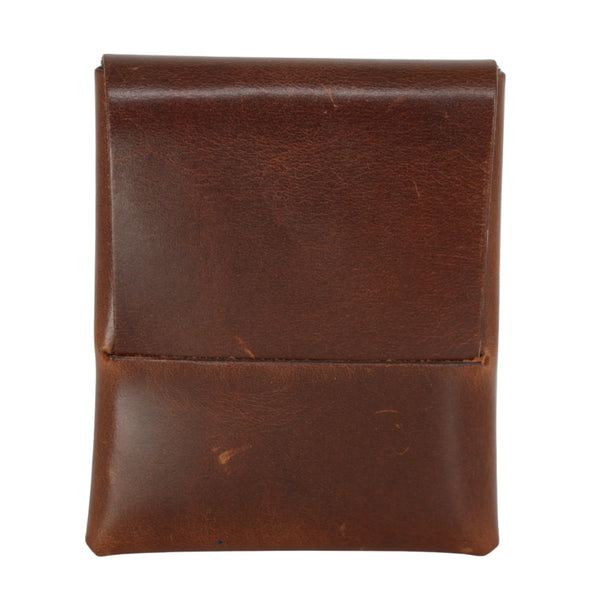
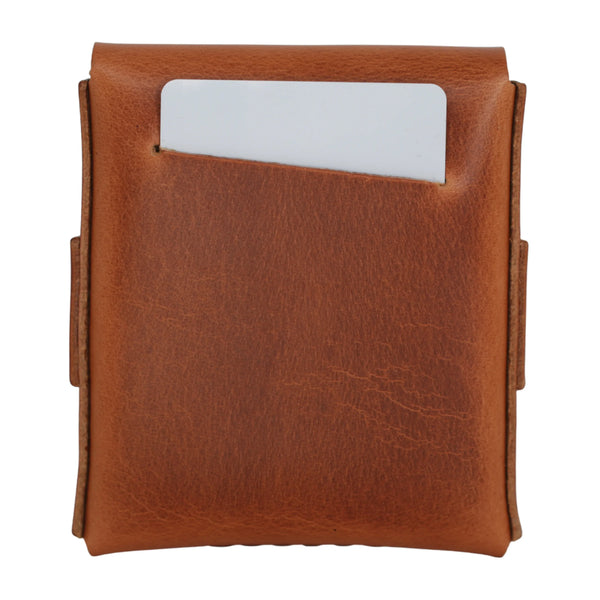
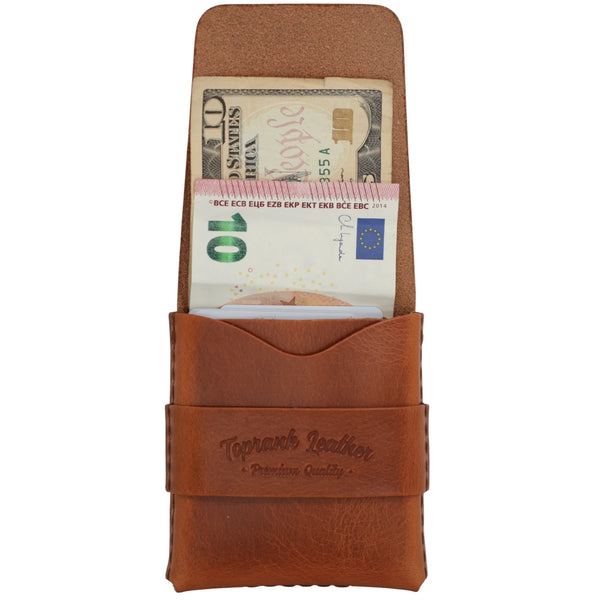
Construction changes what break-in even means. A hand saddle stitched wallet breaks in at the fold and the slots. A folded, stitchless card holder has no seam to soften, so nearly all of its movement happens at a single crease. Which construction suits which carry is the subject of card holder, bifold or trifold.
Frequently Asked Questions
How long does it take to break in a leather wallet?
Two to six weeks for a vegetable tanned full grain wallet in daily pocket carry. That range is a description of typical use, not a property of the wallet. The leather responds to handling, so a wallet kept in a bag and opened twice a week can still feel new after several months.
Does a thin card holder break in faster than a thick wallet?
No. Cut from the same leather, they soften at the same rate. Thickness changes how firm the wallet feels at the start and how much it can hold, not how quickly the fibres give. Where that thickness comes from in the first place is answered in what makes a leather wallet thick.
Can I speed it up safely?
Only by carrying it more. Loading it fully and handling it every day is the whole accelerator, and it is the one method that costs nothing. Every mechanical or chemical shortcut trades weeks of stiffness for a permanent change in the leather.
Will my wallet get thinner as it breaks in?
No. The leather does not lose thickness. It becomes more flexible and packs down around its contents, so a broken-in wallet sits flatter with the same amount inside.
Is it normal for a new wallet not to close flat?
Yes, for the first few weeks under a full load. If it still springs open after a month of daily carry, the fold has not been worked enough — keep it in a pocket rather than a bag, and open and close it deliberately for a week.
What about the water-and-shape method leathercrafters use?
Wet moulding is a real technique, done deliberately on a form, at controlled moisture, and air dried slowly. It is a making process, not an owner's break-in method, and it is not reversible if you get it wrong on a finished wallet.
Does a stiff wallet mean the leather is low quality?
Usually the opposite. Firmness out of the box points to a vegetable tanned full grain with no softening finish applied. Leather that is soft on day one is generally chrome tanned, corrected, or thin.
The Short Version
Buy the wallet, fill it, and put it in your pocket. In two to six weeks it will close flat, hold its fold, and take its cards without a fight, and none of that requires a product or a technique.
The mistakes that matter are the ones that cannot be undone. Do not soak it. Do not dry it with heat. Do not condition it before it has settled. Vegetable tanned leather has been measured shrinking at temperatures a hairdryer clears easily, and once that structure contracts, the wallet you get back is not the one you bought.
Our wallets and card holders are cut from vegetable tanned full grain and hand stitched in Istanbul, which is why they arrive firm and why they are still worth carrying in ten years.
Sources
- ISO 3380:2015, Leather — Physical and mechanical tests — Determination of shrinkage temperature up to 100 °C. International Organization for Standardization. iso.org — retrieved 8 August 2026.
- Ferraris, S., Gamna, F., Luxbacher, T., et al. Comparative characterization of leather from different tanning processes as a contribution for a sustainable development of the leather industry. Scientific Reports, 2025. Scientific Reports — retrieved 8 August 2026.
- SATRA Technology, Determining leather shrinkage temperature (method SATRA TM17:1997). satra.com — retrieved 8 August 2026.