How Many Cards Should a Wallet Hold?
Bu yazıda
As many as you actually carry, and no more. That sounds like a non-answer until you know what happens at the other end: a card slot stretched by overloading does not tighten back up. Every other complaint about a new wallet sorts itself out with use. This one is permanent.
So the question is not which wallet holds the most. It is which wallet is built for the number you already carry, because buying above that number costs you nothing and buying below it slowly ruins the wallet.
Key Takeaways
- Count the cards in your current wallet before you shop. That number, not a maximum, is the spec that matters.
- Overloading is the one damage you cannot undo. A slot that has stretched stays stretched, while stiffness, creases and scratches all resolve themselves.
- Capacity is a design limit, not a target. A wallet rated for ten cards is not improved by putting twelve in it.
- Two cards in one slot is the most common way a slot gives, and it is 1.52 mm of card in a pocket cut for 0.76.
- The leather the maker chose sets how much margin a slot has before it gives.
Start by Counting, Not by Shopping
Open the wallet you carry now and put everything on a table. Cards in one pile, cash in another, receipts and cards you have not used in a year in a third.
Most people find three groups. There are the cards used weekly, usually four to six: a bank card, a transit or building pass, an ID, a loyalty card or two. There are the occasional ones, another handful that could live in a drawer. And there is the dead weight, which is anything expired, duplicated or forgotten.
The weekly pile is what to buy for. The occasional pile is what makes people buy one size up and then regret the bulk. The dead weight is the reason so many wallets look overstuffed.
That count is a better guide than any product page, including ours, because it describes your actual carry rather than a maximum the design can survive.
What Happens When You Go Over
Leather stretches under sustained load and does not spring all the way back. In a card slot, that means the mouth of the pocket widens permanently around whatever was forced into it.
This is worth being blunt about, because it is the only part of owning a leather wallet that is genuinely one-way:
- The fold recovers. A new wallet that will not stay shut settles within weeks of carry.
- Stiffness recovers. Firm leather softens as the fibres learn where they bend.
- Scratches recover, in the sense that they burnish into the surface and stop reading as damage.
- A stretched slot does not. Once it has given, the card sits loose in it for the rest of the wallet's life.
Loose slots are not only an annoyance. A card that slides freely works its way out in a back pocket, and the wallet stops doing the one job it has.
Which leather went in decides how much margin you have. A firm, well-tempered vegetable tanned hide resists that stretch and holds its slots for years. A softer or more loosely structured leather gives sooner, which is why a wallet that feels pleasant in the shop can disappoint in its second year. It is also why we would rather send a wallet out too firm than too soft — the break-in period is a few weeks, and the alternative is permanent.
Is Your Current Wallet Already Overloaded?
You can answer this in about a minute, and the wallet you own is a better test subject than any product page.
1. Empty it and see whether it closes flat. Take everything out and set the wallet down. A wallet that still sits open, or holds a wedge shape with nothing in it, has been carrying more than it was cut for long enough to take a set. A well-loaded wallet returns to flat when emptied, however long you have had it.
2. Compare a busy slot with a quiet one. This is the most useful check, because it controls for the leather and the age — both slots are the same hide, cut the same day. Find the slot you use every day and one you rarely touch. Put the same card in each. If the busy one takes it loosely while the quiet one grips, that slot has given, and the difference is the damage.
3. Turn it over and shake it, gently. Cards should stay put. A card that slides out under its own weight will eventually do the same in a back pocket.
4. Look at the closure under load. If a strap only just reaches, or a snap needs pressing rather than closing, the wallet is carrying past its design. That tension is being paid for somewhere, usually at the fold.
The first check tells you about the wallet's history. The second tells you whether a specific slot is already lost. Neither has a fix, which is why they are worth running before you decide what to buy next rather than after.
What About Two Cards in One Slot?
It is the most common way a slot gives, and the numbers explain why.
A bank card is 0.76 mm thick under ISO/IEC 7810, the standard every payment and ID card is made to. A slot cut for one card is being asked to hold 1.52 mm when you double up, which is twice the load in a pocket with no spare room designed into it.
Thin cards double up more forgivingly than embossed ones, and doing it once while you sort out a replacement card harms nothing. Doing it as a habit is what wears the slot out. The leather carries that load every hour the wallet is in your pocket, not for the few seconds you are looking at it.
Where those millimetres go, and how they add up against the thickness of the leather itself, is covered in what makes a leather wallet thick.
The Stitchless Case Is Different
If the wallet is a folded one-piece with no seam, capacity behaves differently again.
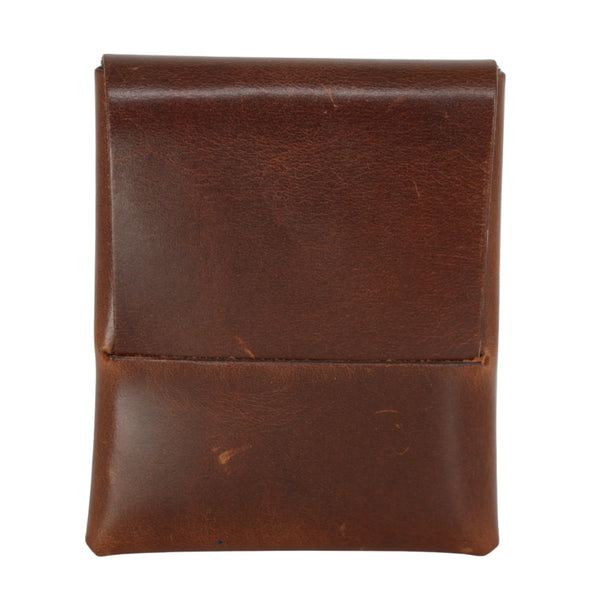
A sewn wallet's slots are defined by stitch lines, and each slot gives independently. A stitchless card holder gets its pockets from how a single panel folds back on itself, so the load is carried by the fold rather than by a row of seams. Overfill it and you are not stretching one slot. You are opening the fold, which is the structural joint of the whole wallet.
That makes the stated capacity firmer on a folded design than on a sewn one. There is less slack to borrow.
What Do You Do With the Cards You Only Sometimes Need?
Stop treating the wallet as storage. That is the whole answer, and it is harder to act on than it sounds.
Cards used once a month do not need to be in your pocket for the other twenty-nine days. A drawer at home, the car, or a second small holder covers them without costing you anything daily. Loyalty cards are the biggest offender, and most now live in an app, which removes them from the count entirely rather than relocating them.
The two categories worth checking honestly are the just-in-case cards and the sentimental ones. A spare bank card carried in case the main one fails is reasonable, and it is one card. A stack of cards kept because removing them feels like tempting fate is not a carry decision, it is a habit.
Every card you take out is thickness you get back and slot life you stop spending. It is also the only capacity upgrade available to you after purchase, since the wallet is not going to grow.
Does Your Count Decide the Format Too?
Partly, and less than most people assume.
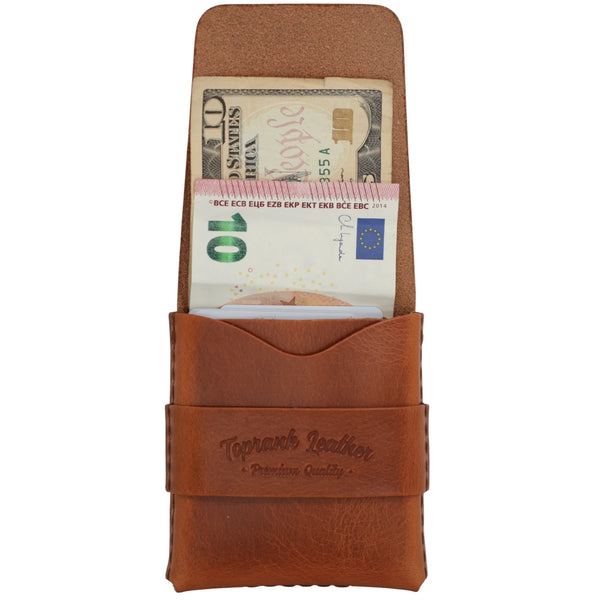
Nearly every wallet format is made in a size that holds six to twelve cards, so the count mostly tells you which size to buy rather than which shape. What settles the shape is cash: whether you carry notes, and whether you are willing to fold them. A card holder has no full-length compartment and a bifold does, and that single difference sorts the formats faster than any capacity figure.
The full comparison, including why we do not make a trifold, is in card holder, bifold or trifold. Read the capacity on a product page as a ceiling rather than a promise once you have picked the format. Our wallets and card holders list it per model, and the figure describes what the design survives, not what it enjoys.

Frequently Asked Questions
How many cards can a leather wallet hold?
Each of our product pages lists a capacity for that specific model, and the range across the collection runs from a slim few to a dozen. The number worth acting on is not the maximum on the page but the count from your own wallet.
Can I put two cards in one slot?
You can, and it is the most common way slots get stretched. A slot cut for one 0.76 mm card is holding 1.52 mm when you double up, every hour it is in your pocket.
Will a stretched card slot go back to normal?
No. That is the one part of leather wallet ownership that does not recover. Everything else — the fold, the stiffness, the surface — settles with use.
Is a thicker wallet worse?
Not by itself. A wallet carrying its designed load sits flatter in a pocket than a smaller one carrying too much. Thickness is decided by what you put in far more than by what the wallet started at.
Should I buy one size up to be safe?
Only if your count says so. An underloaded wallet breaks in around a shape you will not keep, so buying well above your carry is its own small waste. Buy for the number you counted.
What if my carry changes?
Most people's settles quickly. If yours genuinely varies, the flexible answer is a full-length compartment. It absorbs the extra without pushing anything into slots that were not cut for it.
The Short Version
Count what you carry. Buy for that number. Read the capacity on a product page as a limit rather than an invitation.
Everything that bothers you about a new leather wallet fixes itself with a few weeks of use. The exception is a slot you stretched by asking it to hold more than it was cut for, and that one is with you for as long as you keep the wallet.
Our wallets and card holders are hand stitched in Istanbul from full grain vegetable tanned leather, and each product page lists what that model is built to carry.
Sources
- ISO/IEC 7810:2003, Identification cards — Physical characteristics. International Organization for Standardization. iso.org — retrieved 25 August 2026.