What Makes a Leather Wallet Thick?
Bu yazıda
Four things set the thickness of a leather wallet, and you control exactly one of them. The leather's own thickness and the number of layers stacked at any one point are decided at the cutting table. Whether the design carries a full-length cash compartment is decided there too. What you load is yours.
The useful surprise is how small the units are. A bank card is 0.76 mm thick by international standard, and a single layer of wallet-weight leather is roughly 1.6 mm. So one layer of leather is worth about two cards, and a wallet that annoys you in the pocket is usually losing that argument at the construction stage rather than the loading stage.
Key Takeaways
- A bank card is 0.76 mm thick. That figure is fixed by ISO/IEC 7810 and is the same in every wallet on earth.
- One layer of 4 oz wallet leather measures about 1.6 mm, so each layer costs roughly what two cards cost.
- Construction decides thickness far more than capacity does. A stitched card slot stacks leather; a folded one-piece panel does not.
- Our thinnest wallet measures 13 mm closed and empty and holds twelve cards. The thickest measures 18 mm and holds ten.
- Thinner leather is not the way to a thinner wallet. It is the way to slots that stretch and stay stretched.
- After purchase, the only thickness left to change is the load. Ten cards are 7.6 mm of plastic before the leather is counted.
Every number below is either measured in our workshop or taken from a published standard, and the sources are listed at the end. Wallet thickness is one of the few things in this trade that can be settled with a ruler instead of an adjective.
How Thick Is One Layer of Leather?
About 1.6 mm for the weight used in wallets, and the trade measures it in ounces rather than millimetres.
Leather weight is a thickness measurement dressed up as a mass measurement. One ounce equals one sixty-fourth of an inch, or close to 0.4 mm. So 4 oz leather runs about 1.6 mm, and Weaver Leather Supply classifies 4 to 5 oz as standard pouch and wallet weight while putting belts at 8 to 9 oz.
That is the weight our wallets are cut from, and it is the same hide sold by the sheet in the leather sheets collection. The sheet size guide covers why 4 oz sits where it does: thick enough to hold a fold without a lining, thin enough to stitch by hand.
Hold that number, because everything else in this article is arithmetic on top of it. One layer, 1.6 mm. Two layers where a panel folds, 3.2 mm. The wallet is built out of that unit.
Why Construction Sets the Rest
A card slot is not a hole in the leather. It is a second piece of leather laid over the first and fixed along three edges, so every slot adds its own layer to the stack.
Stack four slots up a panel in the usual staggered way and the leather at the bottom of that panel is several layers deep, while the leather at the top is one. That is why a stitched wallet is wedge-shaped when you look at it edge on, and why the thick end always sits at the spine.
A folded one-piece card holder builds its pockets differently. The panel folds back on itself, and the pockets come from those folds rather than from applied slots, so the leather stays close to a single thickness across most of the piece. The stitchless construction guide covers how that works and what it costs elsewhere.
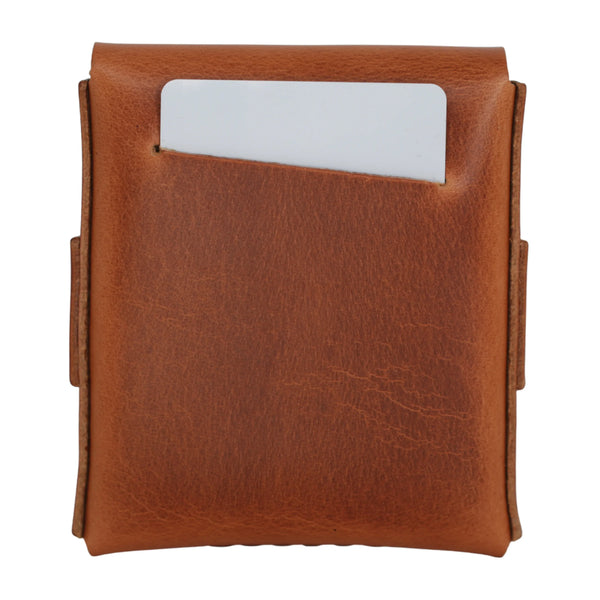
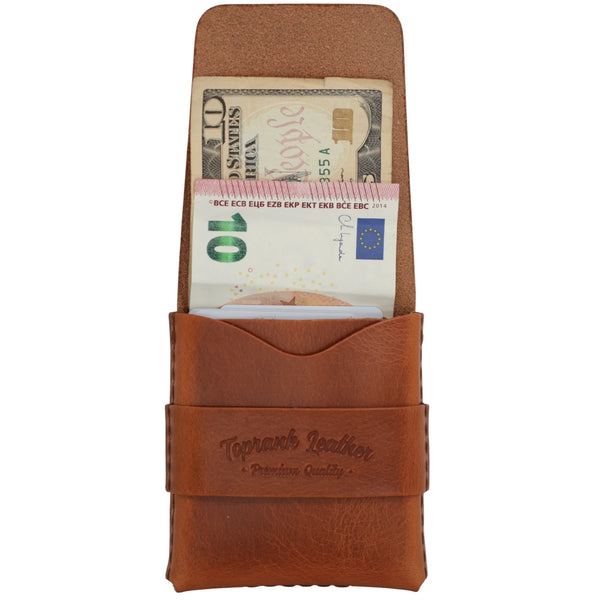
The measurements make the difference plain. Our Flint is a folded stitchless card holder: 13 mm closed and empty, cut for twelve cards. The Slade Slim is a stitched card holder of similar footprint: 17 mm closed and empty, cut for ten. Four millimetres more leather, two cards fewer.
None of that makes stitched construction wrong. Applied slots grip a card more firmly and let a design carry a proper cash compartment, which is why the choice of format comes before the choice of thickness.
How Much of Your Wallet Is Actually Cards?
More than most owners assume, and this is the part with a hard number behind it.
Payment cards, ID cards and most loyalty cards are made to the ID-1 format in ISO/IEC 7810: 85.60 mm by 53.98 mm, with a nominal thickness of 0.76 mm. The standard is why every wallet slot in the world is roughly the same width, and why a card from one country fits a wallet from another.
Ten cards is therefore 7.6 mm of plastic. Not an estimate, not a range.
There is a tempting piece of arithmetic here that deserves a warning. Dividing 13 mm by 1.6 mm gives about eight, and it is easy to conclude that the wallet is eight layers of leather at its thickest point. It is not that simple. A fold takes up more room than the two layers it creates, and empty slots leave small air gaps that close under load.
So the division gives you a ceiling rather than a count. What it does show honestly is the scale of the thing: a wallet in this range is a small number of leather layers, and each one you add is felt.

Does a Thinner Wallet Need Thinner Leather?
No, and this is the trade where slim wallets most often go wrong.
Dropping from 4 oz to 2 oz halves the leather and takes real millimetres out of the finished piece. It also halves the material holding a card slot open. A slot cut in thin, softly tempered leather has very little margin before it gives, and a card slot that has stretched does not tighten back up. That is covered in detail in how many cards a wallet should hold.
Firm leather resists in a way thin leather cannot. Vegetable tanned full grain is dense because the tannins pack the fibre bundles tight, which is the same property that makes a new wallet feel like a board for the first few weeks. The break-in guide explains why that stiffness is worth waiting out.
The honest way to make a wallet thinner is to remove layers, not to thin the leather in the layers you keep. That means fewer slots, a folded construction instead of applied slots, or no cash compartment. Each of those costs you a function, and the product page should tell you which one.
The Only Thickness You Control After Buying
The load, and it moves the number more than any design decision available to you at checkout.
Take a wallet listed at 13 mm closed and empty. Put ten cards in it and you have added 7.6 mm of plastic to a space that was not empty air to begin with. Add folded notes and receipts and the closed figure stops resembling the listed one.
Three things reduce it, in order of how much they give back:
- Remove the cards you do not use weekly. Every card taken out returns 0.76 mm, and most people are carrying three or four that live in an app or a drawer.
- Stop doubling cards in a slot. Two cards in one slot is 1.52 mm in a pocket cut for 0.76, and it is the most common way slots stretch.
- Empty the cash compartment of things that are not cash. Receipts compress badly and hold their creases, so they take more room than their thickness suggests.
A wallet carrying its designed load sits flatter in a pocket than a smaller wallet carrying too much. That is the whole case against buying on the closed-and-empty figure alone.
Frequently Asked Questions
How thick is a credit card?
0.76 mm. ISO/IEC 7810 sets the ID-1 format at 85.60 by 53.98 mm with a nominal thickness of 0.76 mm, and bank cards, driving licences and most ID cards follow it.
How thick should a leather wallet be?
Closed and empty, most well-made leather wallets sit between about 10 and 20 mm depending on format. Ours are measured individually and run from 13 to 18 mm, with the figure listed on each product page.
What leather thickness is used for wallets?
Typically 3 to 5 oz, which is roughly 1.2 to 2 mm. We cut at 4 oz, about 1.6 mm, which holds a fold without a lining and can still be stitched by hand.
Does a lining make a wallet thicker?
Yes, by the thickness of the lining plus the adhesive layer, at every point it covers. Our wallets are unlined, which removes that layer and also removes the most common failure in cheap wallets, where a lining separates from the leather.
Will my wallet get thinner as it breaks in?
It will sit flatter, but the leather does not lose thickness. The fibres become more willing to bend and the contents pack down, so the same load closes tighter than it did in week one.
Is a thick wallet bad for the leather?
Thickness by itself is not a problem. Thickness caused by overloading is, because the load is being carried by slots and folds that were cut for less.
The Short Version
A wallet's thickness is a stack of small, knowable numbers. One card is 0.76 mm. One layer of wallet leather is about 1.6 mm. The rest is how many of each the design puts in one place.
Construction decides most of it before you ever see the wallet, which is why our thinnest model is also the one that holds the most cards. What is left to you is the load, and removing four cards you never use gives back more millimetres than most people expect.
Every wallet in our wallets and card holders collection is measured closed and empty before it is listed, and that figure is on the product page next to the slot count.
Sources
- ISO/IEC 7810:2003, Identification cards — Physical characteristics. International Organization for Standardization. iso.org — retrieved 25 August 2026.
- Weaver Leather Supply, Leather Thickness Chart. weaverleathersupply.com — retrieved 25 August 2026.