Card Holder, Bifold or Trifold: Which Wallet Format Do You Need?
In this article
Cash decides it. Card count gets all the attention on product pages, but it mostly tells you which size to buy within a format. What picks the format itself is whether you carry notes, and whether you mind folding them.
A card holder suits folded notes, or none at all. A bifold gives notes a full-length pocket so they go in flat. A trifold gives them the same pocket in a shorter, thicker package. That is the whole decision, and everything below is the reasoning behind it.
Key Takeaways
- Cash, not card count, decides which format you need. Cards decide which size you buy inside that format.
- Thickness does not track capacity. Our thinnest wallet holds the most cards: the Flint carries twelve at 13 mm closed, while the Slade Classic carries ten at 18 mm.
- Every format fails somewhere specific. Card holders give at the slots, bifolds give at the spine, trifolds stack leather at two fold lines instead of one.
- A trifold buys you a shorter footprint and pays for it in thickness. That trade is the reason we do not make one.
- Buy for the carry you have most weeks, not for your heaviest week of the year.
One thing worth saying before the definitions. None of these formats is a compromised version of another. A card holder is not a small bifold, and a bifold is not a card holder that got out of hand. They are answers to different questions about cash.
What Is a Card Holder, a Bifold and a Trifold?
The names describe folds, not sizes, and that is the useful way to read them.
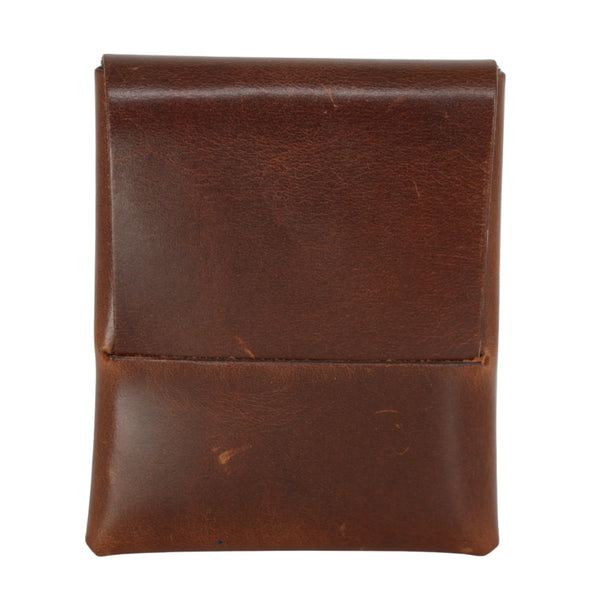
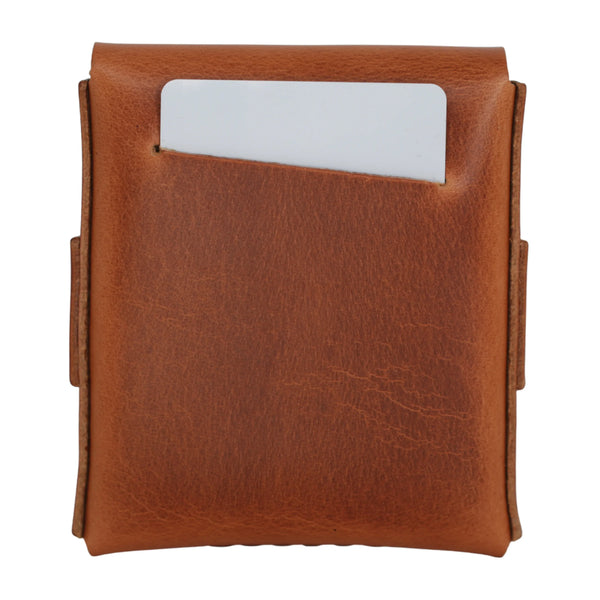
A card holder has no full-length cash compartment. Cards sit in slots or in a folded pocket, and notes go in folded, usually once, tucked behind the cards or under a flap. Some card holders fold and some do not. What defines the format is the absence of a pocket sized for a flat banknote.
A bifold folds once. Open it and the two inner panels carry cards, while a single compartment runs the full length of the spine for notes. Bills go in unfolded. The closed wallet is about half the length of a banknote, which is where the familiar shape comes from.
A trifold folds twice. Three panels stack into a closed wallet roughly a third of the open length, so the footprint is squarer and shorter than a bifold. The cash compartment still runs along the spine, and the extra panel adds card slots.
This range covers the first two. The wallets and card holders built in Istanbul run from folded one-piece card holders to strap-closed wallets with a full-length compartment, and the section further down explains why the trifold is missing.
Cash Decides the Format, Not Card Count
Most buying guides open with card capacity because it is the easiest number to print. It is also the number least likely to change your mind, because nearly every format is available in a size that holds six to twelve cards.
Cash is different, because a banknote has a fixed length and leather does not negotiate with it. Either the wallet has a pocket that fits a flat note or it does not. That single fact sorts the formats faster than any spec sheet.
Three questions settle it in about a minute:
- Do you carry notes at all in a normal week? If the honest answer is no, a card holder is the correct format rather than the smaller one.
- Do you mind folding them? Folded notes crease at the corners and wear along the fold. Plenty of people genuinely do not care.
- Is your cash occasional but real? This is the awkward middle, and it is where a full-length compartment earns its size. It absorbs a sudden fold of notes without pushing anything into card slots that were not cut for it.
That last case catches more people than they expect. Card payments have not removed cash so much as made it lumpy: nothing for a month, then a market, a trip, or a country where a card is less useful.
Does a Wallet That Holds More Sit Thicker?
No, and the workshop measurements make the point better than an argument would.
Every wallet in the range is measured closed and empty before it is listed. Set four of them side by side and the pattern that most people expect simply is not there.
The Flint is the thinnest thing on that chart and the highest capacity on it. It gets its pockets from folding a single panel back on itself, so the leather is one thickness almost everywhere.
A stitched wallet works differently. Each slot is a piece of leather laid over the one beneath it and sewn down, so the stack grows towards the spine. That is why the Slade Slim sits 4 mm thicker than the Flint while holding two fewer cards. The stitchless construction guide covers how a folded one-piece design gets away with this.
The practical version: if pocket thickness is what you actually care about, look at the construction and the cash compartment. Card count is close to irrelevant to it.
How Each Format Fails
A format is easier to choose once you know where it gives up. All three fail in a predictable place, and only one of those failures is permanent.
Card holders give at the slots. They have the least spare room, so an owner who carries one extra card per slot finds the mouth of the pocket widening around it. That stretch does not come back, which is covered in full in how many cards a wallet should hold. On a folded stitchless holder the risk moves to the fold itself, because the fold is the structural joint rather than a row of seams.
Bifolds give at the spine. Every open and close is a bend at the same line, and the cash compartment quietly invites receipts, tickets and cards that have no slot. A bifold rarely fails from cards. It fails from becoming a filing cabinet, at which point the spine carries a load it was not cut for.
Trifolds give at two folds instead of one. Two fold lines mean two places where the leather has to bend and stack, and the middle panel is loaded from both sides at once. It is the format with the most layers stacked in the smallest footprint, which is exactly what a pocket squeezes.
None of that makes any format fragile. A well-cut trifold in good leather outlasts a poorly made card holder easily. It does mean the three formats age differently, and knowing which one you are choosing is worth more than a capacity figure.

Why We Don't Make a Trifold
Because the trade it offers is one we would rather not sell, and being straight about that is more useful than pretending the format does not exist.
A trifold shortens the closed footprint by adding a panel. The leather does not disappear when it folds a second time; it stacks. So the wallet that fits a smaller pocket outline is also the wallet that sits deepest in that pocket, and depth is what people actually feel when they sit down.
That trade makes sense for some carries. If you want a squarer wallet for a jacket pocket and you are relaxed about thickness, a trifold is a reasonable buy and we would not talk you out of it.
It does not fit what we build around. Our wallets are cut from firm vegetable tanned full grain leather, which is chosen for structure rather than softness. Firm leather and two fold lines pull against each other. The leather that holds a slot open for ten years is the leather least willing to stack three panels deep and still close flat.
So the range covers the folded card holder at one end and the strap-closed wallet at the other. If you need a trifold, buy one from someone who has committed to it properly.
Which Format Fits Your Carry?
Empty your current wallet onto a table first. Cards in one pile, notes in another, and everything you have not touched in a year in a third. Most people land in one of three carries.
The tap-and-go carry. Three to eight cards, no notes or one folded one, phone and keys in the same pocket. A card holder is the right format here, not the budget version of a real wallet. Something with a full-length compartment will ride half empty and break in around a shape you are not filling.
The everyday carry. Six to ten cards, cash most weeks, the occasional receipt worth keeping. This is where a bifold or flap wallet stops being bulk and starts being the thing that keeps your notes flat. The collection lists the compartment layout for each model.
The travel-heavy carry. Ten or more cards, more than one currency, tickets and documents that are not card-shaped. The full-length compartment does most of the work, and the honest advice is that no wallet format is a document folder. Splitting the load across two things beats forcing one to hold everything.
Buy for the carry you have most weeks. A wallet bought for your heaviest fortnight of the year spends the other fifty weeks underloaded, and an underloaded wallet settles into a shape you will not keep.
Frequently Asked Questions
Is a card holder a real wallet?
Yes, if your carry has no flat cash in it. The format is defined by what it leaves out rather than by being smaller, and for a cardless carry there is nothing missing.
Can you carry flat banknotes in a card holder?
Not without folding them. Some card holders take a folded note behind the cards comfortably, and ours do. A note that has to be flat needs a compartment cut for it.
Which wallet format is best for a front pocket?
The one that sits thinnest once loaded, which usually means a card holder or a wallet with fewer stitched layers. Closed-and-empty thickness is only a starting point, because what you put in changes it more than the wallet did.
Are trifolds worse than bifolds?
They are not worse, they are shorter and thicker. A trifold trades footprint for depth, and whether that is a good trade depends on the pocket you carry it in.
Which format lasts longest?
The one carrying the load it was cut for. Format matters far less to lifespan than the grade of leather, the construction, and whether the owner overloads it.
Should I size up in case my carry grows?
Only if you have a reason to expect it. Buying well above your count costs you a wallet that breaks in half empty, and capacity you do not use is not stored for later.
The Short Version
Answer the cash question first. No notes, or folded notes you do not fuss over, points to a card holder. Notes you want flat point to a bifold or flap wallet. A trifold gives you the same flat notes in a shorter, thicker package, and that is the only real difference.
Then pick the size inside that format from the number of cards you counted, not from the maximum on a product page. Thickness will be decided by construction and by what you load, which is why our thinnest wallet is also the one that holds the most.
Our wallets and card holders are hand cut and hand stitched in Istanbul from vegetable tanned full grain leather, and every product page lists the closed measurement and slot count for that model.