What Size Leather Sheet Do You Need? A Project-by-Project Guide
In this article
For most small leather goods, a 6"×12" sheet is one project. A 12"×12" sheet is two or three. A 24"×12" sheet is where you stop rationing and start making mistakes without paying for them.
That's the short answer, and for a first purchase it's usually enough. The longer answer is a method you can run on any project before you buy — count the layers, add the allowances, then add the waste that nobody mentions.
Key Takeaways
- The three sheets are 72, 144 and 288 square inches. Multiply the two dimensions; there's no trick to it.
- Your project needs far more leather than its finished size. A card holder that measures under 10 sq in closed can eat 35–45 sq in flat, because every layer you see is another layer you cut.
- Plan on using about three quarters of a sheet. Rectangles don't nest perfectly, and the offcuts between pattern pieces are real leather you paid for.
- Buy one size up from what the arithmetic says, at least on your first attempt. Recutting a panel is normal; running out mid-project is not.
- 4 oz is pouch and wallet weight. No sheet on this page will make you a belt, and none of them will hold a stamped impression.
How Big Is Each Sheet, Really?
Multiply the two numbers. That's the whole calculation, and it's worth doing because the jump between sizes is bigger than the names suggest.
Leather is usually sold by the square foot, and a square foot is 144 square inches. So the 12"×12" sheet is exactly one square foot, the 6"×12" is half of one, and the 24"×12" is two. If you're comparing prices against a hide supplier, that's the conversion: length × width ÷ 144 gives you square feet (The Leather Guy, retrieved 2026-08-07).
The Method: Count the Layers
The mistake almost everyone makes on a first project is measuring the finished item and buying that much leather. A wallet that measures 4"×3" closed is not 12 square inches of leather. It's closer to 50.
Here's the arithmetic that actually works, in four steps.
1. Measure the closed footprint
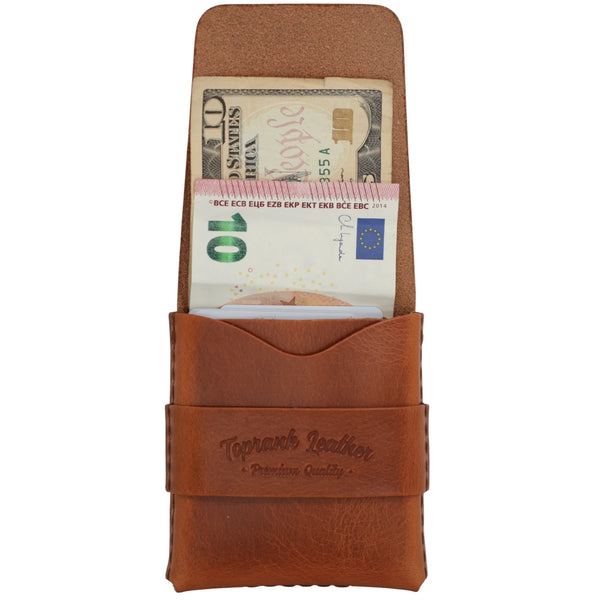
Length × width of the finished item, lying flat and shut. A slim card holder runs about 3.75"×2.5", which is 9.4 square inches. Our own Flint and Slade Slim both sit in that range, and a standard bifold closes at roughly 4.5"×3.75".
2. Count the layers you can see
Look at the item edge-on and count how many thicknesses of leather sit between the front face and the back face. A folded one-piece card holder is typically three or four. A stitched multi-panel card holder can be five or six. A bifold with card slots runs higher still, because each slot is another panel.
Multiply the closed footprint by that count. This is the single number that gets people wrong, and it's why the finished item never looks like it used the leather it used.
3. Add allowances
Add roughly a quarter inch of leather on every edge that gets stitched or folded. That margin isn't decoration — it's what the stitch line sits in, and it's what stops a fold from splitting at the edge.
4. Add waste
Pattern pieces are rarely rectangles, and rectangles don't tile perfectly anyway. Assume you'll use about three quarters of the sheet. More on that below, because it's the part suppliers never mention.
What Each Sheet Actually Yields
Running that method across the projects people most often start with gives the table below. These are figures derived from the arithmetic above, not measurements taken off a specific pattern, so treat them as planning ranges. Your pattern will differ, layer counts vary, and the only number that settles it is the one you work out for the thing you're actually making.
| Project | Rough leather needed | Smallest sheet | Per 24"×12" |
|---|---|---|---|
| Key fob / keychain | 8–15 in² | 6"×12" | 10–15 |
| Luggage tag | 15–25 in² | 6"×12" | 8–12 |
| Folded one-piece card holder | 35–50 in² | 6"×12" | 4–5 |
| Stitched multi-panel card holder | 50–70 in² | 12"×12" | 3–4 |
| Watch strap (two-piece) | 25–40 in² | 6"×12" | 6–8 |
| Knife or multitool sheath | 50–80 in² | 12"×12" | 3 |
| Bifold wallet with card slots | 90–140 in² | 12"×12" | 2 |
| Small pouch or valet tray | 100–150 in² | 12"×12" | 1–2 |
Two things stand out when you look down that table. The first is that a 6"×12" sheet is genuinely a one-project piece for anything wallet-shaped. The second is that the 24"×12" is not four times as useful as the small one for a single item — its value is that you can cut a panel wrong and simply cut another.

Why You Can't Use the Whole Sheet
Because pattern pieces are the wrong shape to tile, and because the parts of a hide you'd trim on a full side have already been trimmed out of a cut sheet.
A rectangular sheet sounds like it should be fully usable, and on paper it is. In practice you're laying down pieces that are rounded, tapered, or slotted, and the space between them is too small to be another piece. That gap is the waste. On small-goods patterns it typically runs a fifth to a third of the sheet.
Keep the offcuts. On a chrome-tanned waxed leather like this one, a scrap the size of a business card is enough to test your stitch spacing, practise a burnished edge, or check how a snap seats before you punch the real panel. That's not thrift for its own sake — it's the difference between finding out on scrap and finding out on the piece you already cut.
What These Sheets Won't Do
Three limits, and it's cheaper to know them now than after the leather arrives.
They won't make a belt. Two reasons, and either one alone would settle it. The longest sheet is 24 inches, and a belt blank needs to be north of 40. And 4 oz is the wrong weight anyway — Weaver Leather Supply's chart puts belt weight at 8–9 oz, roughly 3.2–3.6 mm, against 4–5 oz for pouches (Weaver Leather Supply, retrieved 2026-08-07). A 4 oz belt would stretch and roll within a season.
They won't hold a stamp. This is chrome-tanned leather. Tooling, carving and stamping are vegetable-tanned operations: veg tan cases with water and holds an impression, and chrome tan does not. It can be done, but it takes an arbor press at around a ton of pressure or a heated stamp to make anything last (Leathercraft Garage, retrieved 2026-08-07). If your project is a tooled pattern, buy vegetable-tanned leather and don't let anyone sell you otherwise.
They won't take dye the way bare veg tan does. These sheets arrive finished and waxed in eight colours. That's the point of a pull-up leather, but it means the colour you order is the colour you get.
What they will do is cut cleanly, fold without cracking, hand stitch without a machine, and scuff into a lighter tone that settles back when you rub it. For cut-and-sew small goods, that's the whole job.
Which Size Should You Buy?
Work the method, then buy one size up.
| If you're… | Buy | Why |
|---|---|---|
| Making your first anything | 12"×12" | Room to cut a panel twice, which you will |
| Making one keychain, tag or strap | 6"×12" | Genuinely enough, with scrap left for practice |
| Making one card holder to a known pattern | 6"×12" | Tight but sufficient if you've cut it before |
| Making a bifold or a sheath | 12"×12" minimum | Panel count climbs fast on multi-slot patterns |
| Making several of the same thing | 24"×12" | Nesting gets efficient once pieces repeat |
| Matching colours across two items | One larger sheet | Dye lots vary between sheets; one sheet is one lot |
That last row catches people out. If you're making a matching wallet and key fob as a gift, cut both from the same sheet. Two sheets of the same colour name are not guaranteed to be the same batch, and on a waxed pull-up leather a small difference in the finish is visible side by side.
All three sizes are the same 4 oz Crazy Horse hide in eight colours — the same leather we cut our own goods from.
Frequently Asked Questions
How much leather do I need for a wallet?
Between about 90 and 140 square inches for a bifold with card slots, which means a 12"×12" sheet at minimum and a 24"×12" if you want margin. A slim card holder is far less: 35 to 70 square inches depending on whether it's folded from one piece or stitched from several.
Is 4 oz leather thick enough for a wallet?
Yes, and it's close to ideal. Weaver Leather Supply classifies 4–5 oz as standard pouch weight at 1.5–2 mm. Thinner leather won't hold a fold without a lining; thicker leather makes a wallet that never closes flat.
Can I stamp or tool these sheets?
Not usefully. Chrome-tanned leather doesn't case or hold an impression the way vegetable-tanned leather does. For tooling, carving or stamping, buy veg tan.
What can I make with a 6"×12" sheet?
One card holder, one watch strap, one or two luggage tags, or several keychains — plus offcuts for practice. It is a single-project piece for anything wallet-shaped.
Why does my project need so much more leather than its finished size?
Because every layer you can see when you look at the item edge-on was cut separately and stacked. A card holder that measures under 10 square inches closed commonly uses four times that flat, before seam allowances and cutting waste.
Do the offcuts have any use?
Yes, and keeping them is a habit worth forming early. Scrap is where you test stitch spacing, practise burnishing an edge, and check that a snap seats properly before you punch a hole in the panel you can't replace.
The Short Version
Measure the closed item, multiply by the number of layers, add a quarter inch on every stitched edge, then divide by 0.75 for waste. Round up to the next sheet.
For a first project, round up twice. The extra leather costs less than the evening you'd lose to running short with one panel left to cut — and the offcuts are where you'll do the practising that makes the second attempt come out better than the first.
Our sheets come in 6"×12", 12"×12" and 24"×12", in eight colours, all 4 oz Crazy Horse. If you'd rather see what this leather looks like after a few years of carry before you cut into it, our guide to how leather ages with use covers what changes and what doesn't.
And if you're buying leather anywhere and want to check you're getting what the label claims, start with the four checks for full grain.