

Why Handmade Full Grain Leather Products Take 7–10 Days to Craft
When you order a handmade leather wallet or accessory from Toprank Leather, we tell you it will take 7 to 10 days. Most people assume that is a shipping estimate. It is not. That is how long it takes to actually make the product — by hand, from start to finish.
This guide walks you through every stage of the process. Not because we want to justify the timeline, but because understanding what goes into each day helps you understand what you are actually buying when you choose a handmade leather product.
Table of Contents
- Day 1: Material Selection
- Day 2: Pattern Making and Cutting
- Days 3–5: Assembly and Hand Stitching
- Day 6: Edge Finishing and Burnishing
- Day 7: Conditioning and Surface Treatment
- Days 8–10: Quality Inspection and Final Touches
- Why the Timeline Matters
- FAQ
Day 1: Material Selection

Every handmade leather product begins long before a single cut is made. The first task is choosing the right hide — and it is far more demanding than it sounds.
Full grain leather comes from the outermost layer of the hide, the strongest and most natural part. But not all full grain leather is equal. Within a single hide, fiber density, thickness, and surface quality vary considerably from one section to another. A craftsperson must inspect each panel by hand, identifying which areas are suitable for which components.
At Toprank Leather, we use only full grain vegetable tanned leather sourced from tanneries that meet international quality standards. The vegetable tanning process itself takes weeks — sometimes months — using natural tannins extracted from tree bark. This is in contrast to chrome tanning, which takes 24 to 48 hours but produces leather that is less breathable, less durable, and incapable of developing a genuine patina.
Once the hide arrives, each section is inspected for inconsistencies, blemishes, or weak areas. Any panels that do not meet our standard are set aside. This rejection process — invisible to the customer — is one of the reasons premium handmade leather goods cost what they do.

Day 2: Pattern Making and Cutting
Mass production uses automated die-cutting machines that stamp out dozens of identical pieces per minute. Handmade production is different at every level.
Each product pattern is traced individually onto the chosen leather panels. The craftsperson considers the grain direction, surface texture, and thickness of each section before placing the pattern. This is not guesswork — it is a trained judgment call that affects both the appearance and structural integrity of the finished piece.
Cutting is done with precision knives, not presses. Each cut must be clean and square — a crooked cut edge cannot be fully corrected in later stages. Wing dividers score the stitch line at a consistent distance from every edge, because when this step is skipped, stitches wander and the product looks sloppy even if the stitching itself is good.
A single bifold wallet requires cutting eight to twelve separate pieces. Each one is checked for size and edge quality before the cutting stage is complete.
Days 3–5: Assembly and Hand Stitching
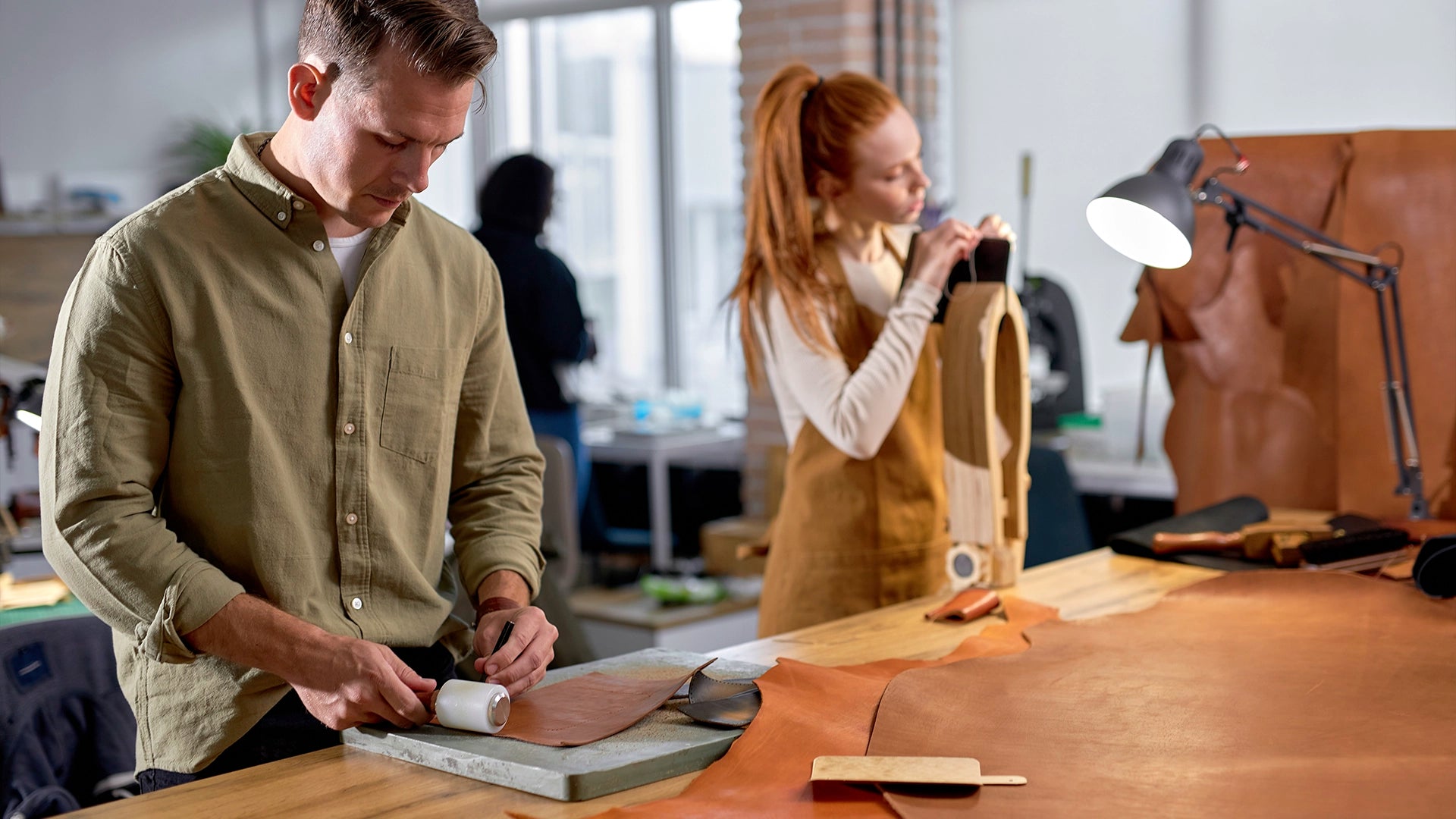
This is where the most time is spent, and where the difference between handmade and machine-made becomes most visible.
Before stitching begins, the leather panels are skived — a technique of thinning the edges where layers will overlap, so the finished product does not feel bulky at the seams. This alone requires skill and a sharp, properly maintained blade.
Then stitch holes are punched by hand using a pricking iron. Each hole must be placed at a consistent depth and angle. A standard bifold wallet has several hundred stitch holes across its seams — each punched individually.
The stitching itself uses the saddle stitch technique: one thread, two needles, each passing through the hole from opposite sides. This creates a self-locking stitch that does not unravel if a single thread breaks. A sewing machine, by contrast, uses a lock stitch that can fail seam-wide if one point wears through. An experienced leathercrafter takes 45 minutes to one hour to stitch a single wallet — a machine does the same in under 60 seconds.
Three days for this stage is not slow. It is how long it takes to do it right across multiple components, checking tension and consistency as you go.
Day 6: Edge Finishing and Burnishing
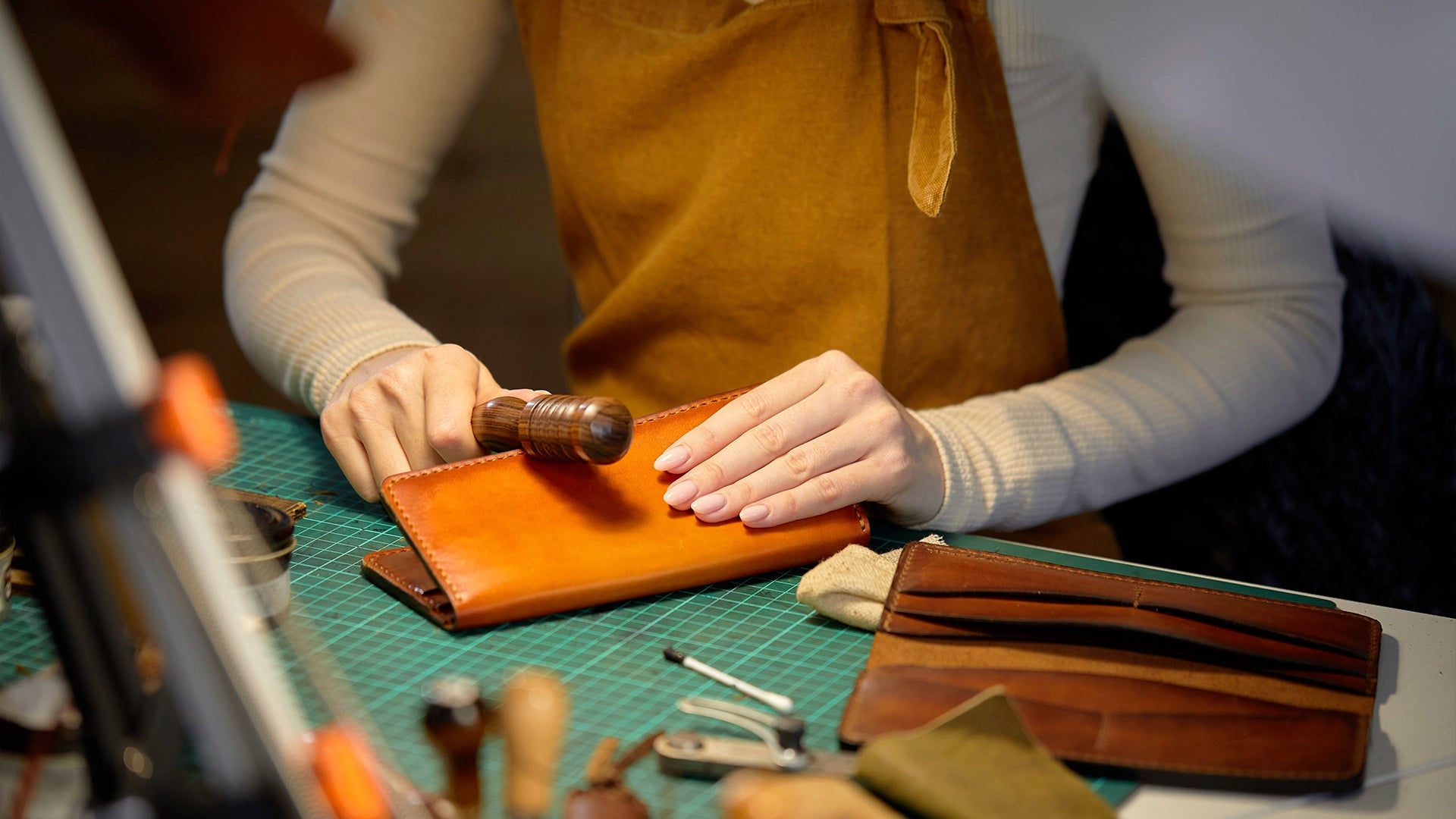
A raw cut leather edge is rough, porous, and vulnerable to fraying. Edge finishing transforms it into a sealed, smooth surface that will last as long as the leather itself.
The process involves several steps. First, a bevelling tool removes the sharp corner from both sides of each edge. Then an edge paint or tokonole compound is applied and worked into the leather fibers. Finally, burnishing — either by hand with a wood slicker or using a motorized burnishing wheel — compresses and polishes the edge fibers until they are dense, smooth, and sealed.
A properly burnished edge feels smooth to the touch, holds its finish over time, and communicates quality without a word. An unfinished or poorly finished edge — rough, fraying at the corners — is one of the most reliable signs of a mass-produced shortcut.
For a wallet with multiple card slots and compartments, this process is repeated across dozens of individual edges. It takes longer than most people expect.
Day 7: Conditioning and Surface Treatment
Before final assembly is complete, each finished piece receives an initial conditioning treatment. Full grain vegetable tanned leather absorbs conditioner deeply — far more so than chrome-tanned or coated leathers — because its surface has not been sealed with artificial finishes.
Conditioning at this stage serves two purposes. First, it restores any moisture lost during cutting, stitching, and edge work — processes that can dry out the leather fibers slightly. Second, it prepares the surface for the patina that will develop with use over the coming months and years.
The conditioner used matters. Natural wax-based conditioners — beeswax, lanolin, or similar compounds — nourish the leather without adding artificial shine or interfering with the patina process. Silicone-based conditioners are faster and cheaper, but they coat the surface rather than penetrating it, reducing the leather's ability to age naturally.
Days 8–10: Quality Inspection and Final Touches
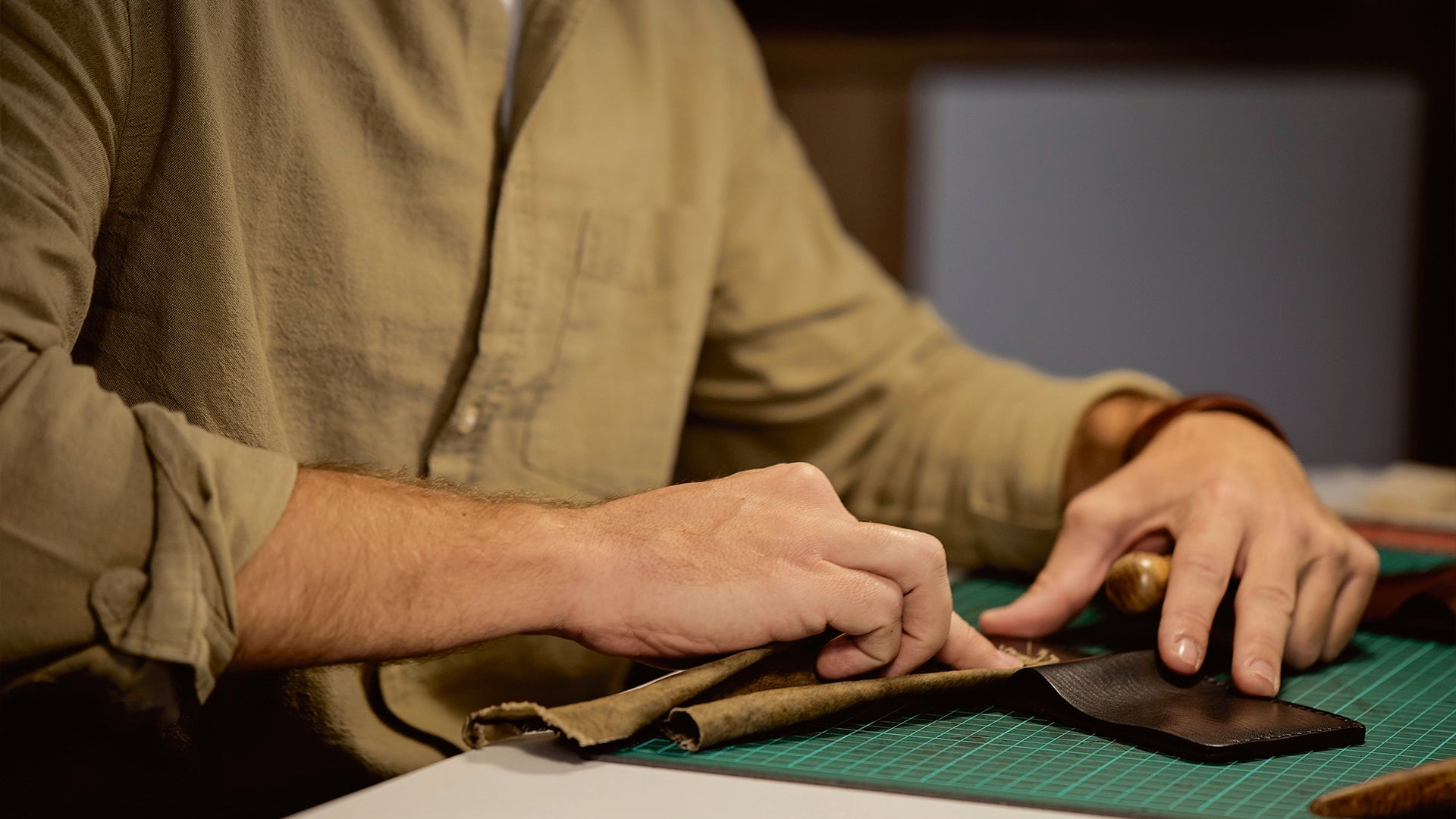
Before any product leaves our workshop, it undergoes a thorough quality inspection. This is not a 30-second glance — it is a structured review of every component and every seam.
Each product is checked against the following criteria:
- Stitch consistency: Even tension throughout, no missed holes, no loose ends
- Edge quality: Smooth and sealed on all surfaces, no raw edges or fraying
- Alignment: All panels correctly positioned, card slots evenly spaced
- Hardware: Snaps, rivets, and closures tested for secure function
- Surface condition: No unintended scratches, marks, or conditioning residue
- Overall construction: Structural integrity when loaded and flexed
Products that pass inspection move to packaging. Products that do not go back to the relevant craftsperson for correction — not replacement, correction. This feedback loop is part of what maintains consistent quality across every piece.
Personalized products — those with engraving, embossing, or monogramming — have this step completed before packaging as well, which adds additional time to the process.
Why the Timeline Matters
There is a straightforward relationship between production time and quality in handmade leather goods: the time cannot be shortened without reducing the quality. Every stage described above requires a specific amount of time to do correctly. Rushing the drying of edge treatment, the saturation of conditioner, or the consistency of stitching produces a product that looks fine on arrival and fails within a year.
Mass-produced leather goods — even those sold at premium prices — are typically completed in hours, not days, using machines, synthetic materials, and production shortcuts that are invisible at point of sale but visible over time. The seams unravel. The edges fray. The surface cracks.
When you order from Toprank Leather's handcrafted collection, the 7 to 10 day timeline is not a delay. It is the production time. And it is the primary reason the products you receive will still be with you in ten or twenty years.
If you want to see the full range of what we make, you can browse our leather wallets and card holders — every piece is made to order, by hand, to the same standard described above.
FAQ
Why do handmade leather products take longer than machine-made ones?
Every step in handmade production — cutting, stitching, edge finishing, conditioning, and inspection — is done by hand with individual attention to each piece. A sewing machine stitches a wallet in under a minute; an experienced leathercrafter takes 45 minutes to an hour using the saddle stitch technique. Multiply that time investment across every stage and every component, and 7 to 10 days is the honest result.
Does the production time affect the quality of the leather?
Yes, directly. Skipping or rushing any stage — edge burnishing, conditioning, or quality inspection — produces a product that looks acceptable on arrival but degrades faster. The 7 to 10 day timeline reflects the time required to complete each stage correctly, not working slowly.
What kind of leather does Toprank Leather use?
We use full grain vegetable tanned leather — the highest quality grade available. The leather retains the full natural grain layer, making it exceptionally strong and capable of developing a rich patina over years of use. The vegetable tanning process uses plant-based tannins rather than synthetic chemicals, which produces leather that ages beautifully rather than cracking or peeling.
Can I get a product faster if I need it urgently?
The production timeline is determined by the physical process — the leather conditioning, edge treatment drying, and quality inspection cannot be safely shortened. If you have a specific delivery deadline, please contact us before placing your order so we can advise on what is realistic.
Is handmade leather worth the longer wait?
A mass-produced leather wallet typically shows significant wear within two to five years. A well-made full grain leather wallet, properly cared for, lasts 20 to 30 years — often longer. When you factor in the replacement cost of a cheaper wallet every few years, handmade leather is almost always the better long-term investment, in both financial and environmental terms.
About the Maker
Every Toprank Leather piece is cut, stitched and finished by hand in our Istanbul workshop — 11 years of full grain, vegetable-tanned leather craft. We publish these guides to share what we learn at the bench, and everything we make is backed by a lifetime warranty.


