Silicone, Plastic or Leather: Which AirTag Holder Actually Keeps the Tag?
In this article
Retention is not a material question. It is a mechanism question, and the two get confused constantly.
A holder keeps your AirTag one of four ways: it stretches around it, it snaps over it, it screws shut, or it makes you remove something else first. Each of those fails differently, and the material only decides how gracefully.
Key Takeaways
- There are four retention mechanisms in this category. Stretch fit, snap fit, threaded closure, and captive closure. Rank them in that order for security.
- Stretch fit is the weakest because elastomers lose elastic memory. The property is real enough to have its own test standard, ASTM D395.
- Snap fit fails on impact rather than over time. It is the mechanism most likely to survive five years and then let go once.
- Captive closure is the only mechanism where losing the tag requires two independent failures.
- Every closed holder reduces the volume of the alarm, leather included. The 2026 AirTag has more headroom for that than the 2021 one did.
- Security and battery access pull against each other. Decide which one you actually need before you compare materials.

The Four Ways a Holder Holds a Tag
Work out which of these you are looking at and you can predict how it will fail before you buy it.
Stretch fit
A silicone or TPU sleeve grips the tag with its own tension. Nothing latches. The tag stays because the opening is smaller than the disc and the material is fighting to close.
This is the mechanism behind most inexpensive holders, and it is the one that quietly degrades. Elastomers lose elastic memory under sustained load, a property real enough that the industry has a standard test for it. ASTM D395 measures the permanent deformation retained by a rubber after prolonged compression, described as the loss of elastic memory from viscous flow and crosslink rearrangement.
The test conditions are not a keyring, so treat this as the mechanism rather than a prediction of months. The point stands: the thing holding your tag in is a material property that does not stay constant, and a sleeve that has been stretched open a hundred times is not the sleeve you bought.
Snap fit
Two hard shells clip together over a ridge. Polycarbonate, ABS, or a moulded plastic of some kind.
This one is reliable until it is not. A snap does not slowly loosen the way an elastomer does; it holds its geometry and then gives way under a specific impact, usually the bag hitting a hard floor at the wrong angle. It is a low-probability, all-at-once failure rather than a creeping one.
Threaded closure
A screw or barrel joins two halves. The tag is behind a fastener rather than behind friction.
This is a genuine step up, because a fastener does not have an opinion about how many times you have opened it. Its failure mode is human: a screw backed off half a turn and never checked. Threaded closures want a look every few months, and almost nobody gives them one.
Captive closure
The holder cannot open while something else is in place. On ours, the keyring passes through the closure, so the tag cannot come out until the ring comes off.
What this buys is not stronger material. It is a second independent failure required before you lose anything. The closure must fail and the ring must fail, and those two events have nothing to do with each other.
So What Does the Material Actually Decide?
Four things, none of which is retention.
- How loud the alarm is. Every closed cover attenuates sound. Density and thickness set how much, so a thick leather holder costs more volume than a thin silicone one. Apple made the 2026 tag's speaker 50% louder, which gives every cover more room to work with.
- What water does. The tag is rated IP67 by Apple, to a metre for thirty minutes. Silicone and plastic shrug water off. Leather has no rating at all and takes a permanent change from a soaking.
- How it ages. Plastic and silicone get scratched, chalky and eventually brittle. Vegetable tanned leather darkens and hardens into something people keep. That is a preference, not a performance claim.
- What it does to your keys. A hard shell rattles against them. Leather does not, which is a small thing you notice every day.
Where Leather Is the Wrong Answer
We make leather holders, so this section is the one to read sceptically. Here is where we would tell you to buy something else.
If it is going to be wet regularly. A boat, a swimming bag, a dog who swims. Leather is not waterproof and no finish makes it so. Water will darken it, and drying it near heat will stiffen it permanently. Buy silicone.
If it needs to be found in the dark. Brown leather in a black bag is a poor combination. A bright shell is genuinely more practical.
If you want the loudest possible alarm. Then use no holder at all and accept that the tag has nothing to attach to. Any cover costs you volume, and we are not going to pretend ours is the exception.
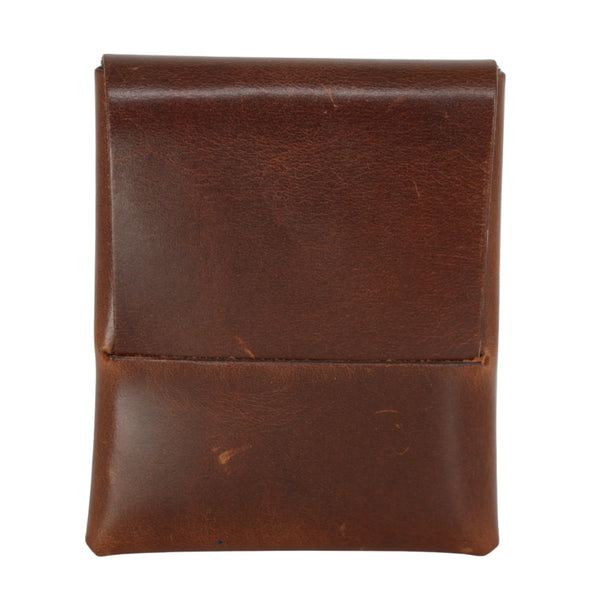
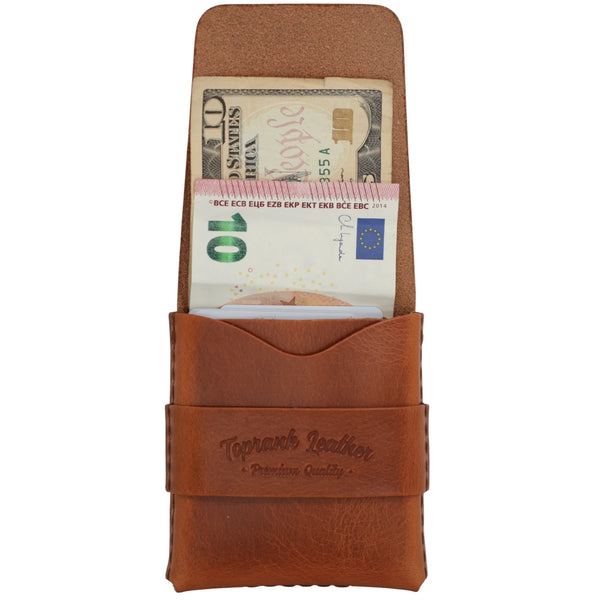
If an open-top leather sleeve is what you are looking at. That is a stretch fit with a different material. It has the same mechanism as a silicone sleeve and roughly the same failure, so judge it as one.
What We Build and Which Failure We Chose
Three holders, three points on that chart. We are not going to claim one is best, because they answer different questions.
The v1.0 is the easy-access end. It is cut from Crazy Horse leather, a wax-and-oil pull-up finish that marks and self-heals as you handle it. Getting the tag out is quick, which is the point and also the trade.
The v2.0 is the threaded one, closed with a metal screw lock and hung on a brass carabiner. Check the screw when you change the battery and it will outlast the tag.
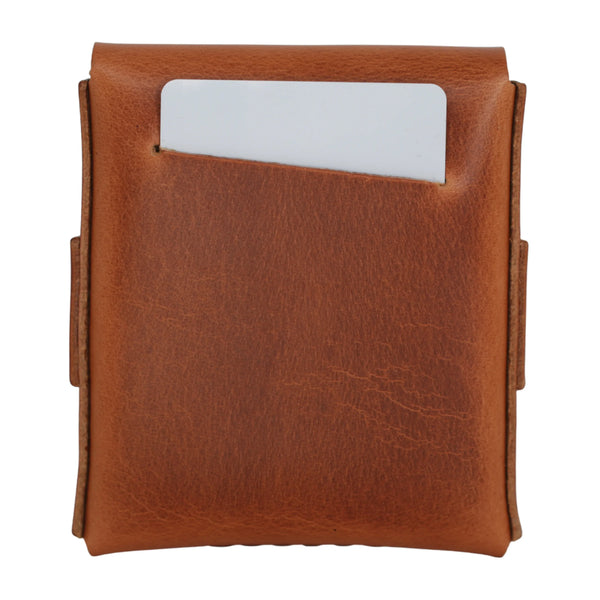
The v3.0 is the captive one. The keyring holds it shut, so the tag stays put until you take the ring off. It is cut from full grain vegetable tanned leather, which is the only tannage that produces a real patina rather than just wear.
All three take either generation of tag, because the disc did not change size in 2026. Which leather ages better on a keyring is a separate question, and we answer it in the Crazy Horse and vegetable tanned comparison.
How to Test the Holder You Already Own
Three checks, no purchase required. Run them on whatever is on your keys right now.
- Shake it hard at head height for five seconds. Any movement you can feel is a tag working its way loose over months. This is the check a tired stretch fit fails.
- Open and close it ten times, then shake again. If the grip is noticeably softer at the end, you have found the loss of elastic memory in your own hand.
- Play Sound from Find My, in and out of the holder. Walk away until you cannot hear it each time. The gap between those two distances is what the cover costs you.
Do the third one before you need it rather than during a search. Knowing your holder costs you five metres is useful information; discovering it in a car park is not.
Frequently Asked Questions
Do AirTags fall out of silicone holders?
The mechanism allows it. A stretch fit relies on the material holding its tension, and elastomers lose elastic memory with sustained load and repeated opening. A worn sleeve holds less well than a new one.
Which AirTag holder is the most secure?
A captive closure, where something else must be removed before the holder opens. It is the only arrangement that needs two independent failures before the tag is gone.
Does a metal AirTag case block the signal?
Dense metal is the material that interferes with radio. Leather, silicone and plastic do not. If a case is fully metal, check how the manufacturer has handled that before buying.
Is leather or silicone better for an AirTag?
Silicone for wet conditions and visibility. Leather for daily carry, quieter keys, and an object that improves rather than degrades. Neither is more secure by material alone; the closure decides that.
Does a case make the AirTag alarm quieter?
Yes, all of them, in proportion to density and thickness. The 2026 tag has a speaker Apple describes as 50% louder, which offsets some of it.
Can I put an AirTag holder on a dog collar?
The retention question gets stricter there, because you are not present when it fails. Choose a threaded or captive closure rather than a stretch fit, and check the attachment monthly.
The Short Version
Ignore the material until you have identified the mechanism. A stretch fit loses grip gradually, a snap fit lets go suddenly, a threaded closure needs occasional attention, and a captive closure requires two failures rather than one.
Material decides sound, water, ageing and whether your keys rattle. It does not decide whether the tag stays in, which is what most people think they are buying.
Our leather AirTag holders are cut and finished in Istanbul from full grain hide. If the tag is going in a bag rather than on a keyring, the placement guidance in our luggage guide matters more than any of this.
Sources
- ASTM International, D395 Standard Test Methods for Rubber Property — Compression Set. astm.org — retrieved 11 August 2026.
- Intertek, Compression Set Under Constant Deflection, ASTM D395. intertek.com — retrieved 11 August 2026.
- Apple, Apple introduces new AirTag with expanded range and improved findability, Newsroom, January 2026. apple.com — retrieved 11 August 2026.
- Apple, AirTag (2nd generation) — Tech Specs. support.apple.com — retrieved 11 August 2026.