Crazy Horse vs Vegetable Tanned: Which AirTag Holder Ages Better?
In this article
Crazy Horse hides the damage. Vegetable tanned records it. On a keyring, which is the hardest place in your everyday carry to keep leather looking new, that difference decides everything.
The comparison is also slightly unfair, because the two words describe different things. Crazy Horse is a wax-and-oil finish. Vegetable tanned is a tannage. A hide can be one, the other, both, or neither.
Key Takeaways
- Crazy Horse names a finish, not a grade or a tannage. Vegetable tanned names how the hide was turned into leather.
- A keyring is the highest-abrasion position in everyday carry. Metal keys, a pocket, and constant motion against fabric.
- That friction works for Crazy Horse. Warmth and rubbing push the wax back, so a scratch made this morning is often gone by evening.
- The same friction works differently on vegetable tanned leather. Marks stay, but the whole surface darkens around them until they read as depth.
- Only vegetable tanned leather develops a true patina. Under light, quinones form on the tannin's phenolic structure and the leather darkens.
- Neither survives heat. Drying either one on a radiator is the single mistake with no repair.

These Are Not Two Grades of the Same Thing
Getting this straight first saves a lot of confusion later.
Vegetable tanned describes the chemistry that stops a hide from rotting. Tannins from bark and plant matter, in pits, over weeks. It is the slow method, and it produces leather that keeps reacting to light, air and your hands for years afterwards.
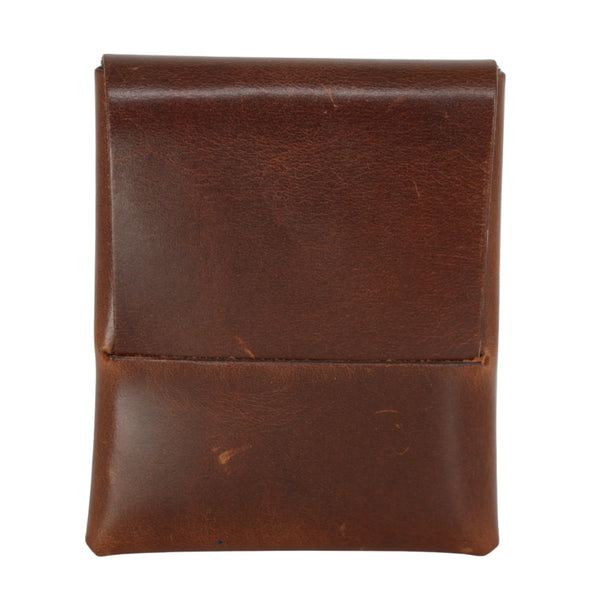
Crazy Horse describes what was done to the surface afterwards. The hide is saturated with waxes and oils so that bending or scratching displaces the wax and leaves a lighter mark, which rubs back out with warmth and friction. That is the pull-up effect, and we go through it properly in our guide to what Crazy Horse leather actually is.
The name guarantees nothing about the hide underneath. Crazy Horse leather can be full grain or it can be a corrected split with a wax coat. Ours is full grain, and that is a claim about our hide rather than about the term.
What Does a Keyring Do to Leather?
More than a wallet does, and this is the part most comparisons skip.
A wallet lives flat in a pocket and gets handled a few times a day. A keychain holder lives in the same pocket as a fistful of cut metal, swings against a thigh with every step, and gets grabbed, dropped and dragged across a table several times an hour.
Three consequences follow, and they apply to any leather you hang on a ring:
- Abrasion is constant rather than occasional. The surface is being polished and scuffed all day, not once in a while.
- Hand contact is heavy. Sebum transfer is one of the four forces behind a patina, and keys get touched more than almost anything you own.
- Light exposure is low. A keychain spends most of its life in a pocket. So the darkening that comes from light happens slower here than on something that sits out on a desk.
That last one matters. If you want a fast patina, a keyring is not the quickest route to it. What you get instead is a burnish from friction, which arrives sooner and looks different.
How Crazy Horse Behaves on a Keyring
This is the position Crazy Horse was made for, and we would say so even if we only sold the other one.
The pull-up finish marks instantly. Drag it across a key and you get a pale line straight away, which alarms people in week one. Then the pocket goes to work. Body heat softens the wax, movement against fabric redistributes it, and the line fades without you doing anything.
The result after a year is not a piece that looks new. It looks worked: a mottled, uneven surface where the wax has been pushed around a thousand times, darker at the edges and lighter across the high points. Some people love it. Some people find it messy, and that is a legitimate reaction rather than a failure of the leather.
What Crazy Horse does not do is develop a patina. Wax moving is not oxidation, and no amount of carrying it will produce the deep amber that vegetable tanned leather reaches.
How Vegetable Tanned Behaves on a Keyring
Slower, and in the opposite direction.
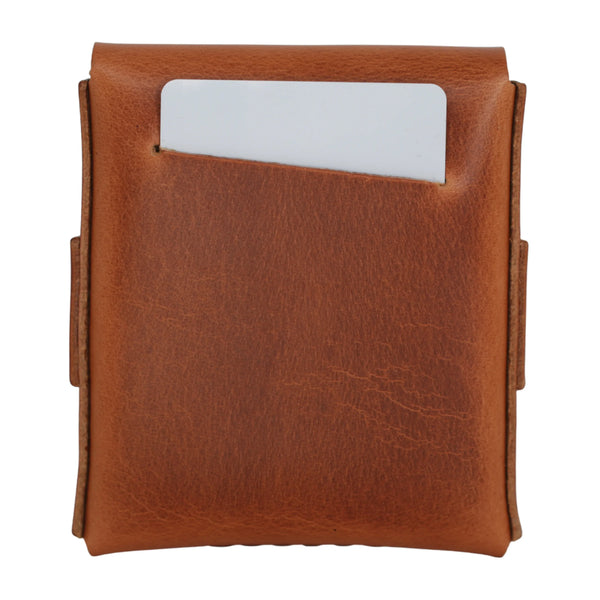
A scratch on vegetable tanned leather does not rub out. There is no wax layer to move back. What happens instead is that the surrounding surface darkens over months until the mark stops standing out against it.
The darkening has a mechanism behind it rather than a marketing story. Research on tannin behaviour in leather describes vegetable tanned leather darkening under irradiation as quinones form on the phenolic structure of the tannin. Add sebum from your hands, oxidation from air, and burnishing from friction, and you have the four forces we cover in the patina guide.
On a keyring specifically, expect the friction burnish before the colour. The high points go glossy first, and the deep amber arrives later than it would on something that sits in daylight.
Which One Should You Choose?
Not by quality, because this is not a quality ladder. Choose by what you want to see in a year.
- Choose Crazy Horse if new-looking matters to you. It self-repairs its own scratches, so it tolerates rough handling without a permanent record. The v1.0 is our Crazy Horse holder.
- Choose vegetable tanned if you want the item to become yours. Every mark stays and every month darkens it further. The v3.0 is cut from full grain vegetable tanned hide.
- Choose Crazy Horse if you are impatient. It looks characterful within a fortnight. Vegetable tanned asks for months before it rewards you.
- Choose vegetable tanned if you are giving it as a gift to be kept. Three years in, it is the one people photograph.
If the closure matters more to you than the leather, which for a lot of buyers it should, the materials and closures comparison is the more useful article.
What Neither of Them Survives
Three mistakes, and the first one is not recoverable on either leather.
Heat. A radiator, a hairdryer, a car dashboard in summer. Heat drives moisture out of the fibre structure and the leather goes hard and brittle. On Crazy Horse it also drives the wax out unevenly. There is no treatment that reverses it, so a wet holder dries slowly at room temperature and nowhere else.
Too much conditioner. Leather conditioner is not a cure-all, and over-oiling softens the fibre until the piece loses its shape and holds the tag loosely. On vegetable tanned leather it also darkens it in patches, permanently. Once or twice a year is plenty on an item this small, and less on Crazy Horse, which arrives saturated with wax and oil already.
Soaking. Neither leather has a water rating and neither is waterproof. The AirTag inside is rated IP67 by Apple to a metre for half an hour; the holder around it is not rated at all. If you regularly get it wet, buy silicone and keep the leather for dry carry.
Test any product you have not used before on a hidden area first, such as the back face near the stitch line. That applies to conditioners, dyes and cleaners alike.
Frequently Asked Questions
Is Crazy Horse leather vegetable tanned?
Sometimes, and the name does not tell you. Crazy Horse describes the wax-and-oil finish on the surface, not the tannage underneath. Ask the maker which tannage they used.
Does Crazy Horse leather develop a patina?
Not in the sense the word properly means. What it develops is a worked, mottled surface from wax being moved around. A patina is a chemical change in vegetable tanned leather, and a wax finish does not produce one.
Which leather is more durable on a keychain?
Both are full grain in our holders, so the fibre structure is comparable. Crazy Horse conceals abrasion better, which reads as durability without being it.
Why does my Crazy Horse holder scratch so easily?
That is the finish doing exactly what it was made to do. The pale line is displaced wax rather than damaged leather, and warmth and rubbing bring it back.
How long until a vegetable tanned holder darkens?
Expect little in the first week, a few shades at contact points within one to three months, and obvious depth by six to twelve. A keyring lives in a pocket, so it darkens slower than something kept in daylight.
Can I speed up the patina by leaving it in the sun?
A little sun accelerates it, but prolonged irradiation eventually flips from darkening into lightening as the collagen degrades. Carry it instead; that is the method with no downside.
The Short Version
Crazy Horse is a finish that hides what happens to it. Vegetable tanned is a tannage that keeps a record. A keyring gives both of them more abrasion than anything else you carry, which pushes each one further along its own path rather than towards a common outcome.
Pick the one whose year-one appearance you actually want. Neither is the better leather, and any brand ranking them is selling you the one it happens to stock.
We cut both in our Istanbul workshop. Our AirTag holders are full grain either way, and both take either generation of the tag.
Sources
- Pizzi, A., Simon, C., George, B., Perrin, D. and Triboulot, M. C. Tannin antioxidant characteristics in leather versus leather light stability: Models. Journal of Applied Polymer Science, vol. 91, no. 2, pp. 1030–1040, 2003. doi.org/10.1002/app.13210 — retrieved 11 August 2026.
- Falcão, L. and Araújo, M. E. M. Vegetable Tannins Used in the Manufacture of Historic Leathers. Molecules, vol. 23, no. 5, article 1081, 2018. doi.org/10.3390/molecules23051081 — retrieved 11 August 2026.
- Apple, AirTag (2nd generation) — Tech Specs. support.apple.com — retrieved 11 August 2026.